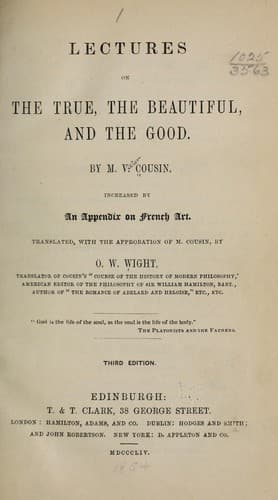
Lectures on the true, the beautiful and the goodCousin, Victor
Philosophy
Lectures on the true, the beautiful and the good
Cousin, Victor
Aesthetics; Ethics; Truth
Disturb this distinction, and you disturb human life and entire society.
Permit me to take an extreme, tragic, and terrible example. Here is a
man that has just been judged. He has been condemned to death, and is
about to be executed--to be deprived of life. And why? Place yourself in
the system that does not admit the essential distinction between good
and evil, and ponder on what is stupidly atrocious in this act of human
justice. What has the condemned done? Evidently a thing indifferent in
itself. For if there is no other outward distinction than that of
pleasure and pain, I defy any one to qualify any human action, whatever
it may be, as criminal, without the most absurd inconsequence. But this
thing, indifferent in itself, a certain number of men, called
legislators, have declared to be a crime. This purely arbitrary
declaration has found no echo in the heart of this man. He has not been
able to feel the justice of it, since there is nothing in itself just.
He has therefore done, without remorse, what this declaration
arbitrarily interdicted. The court proceeds to prove to him that he has
not succeeded, but not that he has done contrary to justice, for there
is no justice. I maintain that every condemnation, be it to death, or to
any punishment whatever, imperatively supposes, in order to be any thing
else than a repression of violence by violence, the four following
points:--1st, That there is an essential distinction between good and
evil, justice and injustice, and that to this distinction is attached,
for every intelligent and free being, the obligation of conforming to
good and justice; 2d, That man is an intelligent and free being, capable
of comprehending this distinction, and the obligation that accompanies
it, and of adhering to it naturally, independently of all convention,
and every positive law; capable also of resisting the temptations that
bear him towards evil and injustice, and of fulfilling the sacred law of
natural justice; 3d, That every act contrary to justice deserves to be
repressed by force, and even punished in reparation of the fault
committed, and independently too of all law and all convention; 4th,
That man naturally recognizes the distinction between the merit and
demerit of actions, as he recognizes the distinction between the just
and the unjust, and knows that every penalty applied to an unjust act is
itself most strictly just.
Public-domain text, read in full here on John Shaqi.
Reviews
Reviews
No reviews yet
Be the first to share your thoughts on this work.
Elsewhere in the archive
Join the Discussion
Join the discussion
Sign in to leave a comment or review.
Sign InorCreate an account