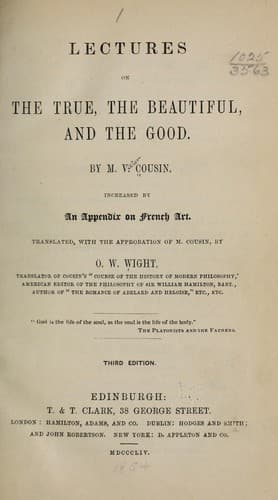
Lectures on the true, the beautiful and the goodCousin, Victor
Philosophy
Lectures on the true, the beautiful and the good
Cousin, Victor
Aesthetics; Ethics; Truth
Such are the foundations of that power of judging and punishing which is
entire society. Society has not made those principles for its own use;
they are much anterior to it, they are contemporaneous with thought and
the soul, and upon these rests society, with its laws and its
institutions. Laws are legitimate by their relation to these eternal
laws. The surest power of institutions resides in the respect that
these principles bear with them and extend to every thing that
participates in them. Education develops them, it does not create them.
They direct the legislator who makes the law, and the judge who applies
it. They are present to the accused brought before the tribunal, they
inspire every just sentence, they give it authority in the soul of the
condemned, and in that of the spectator, and they consecrate the
employment of force necessary for his execution. Take away a single one
of these principles, and all human justice is overthrown, no longer is
there any thing but a mass of arbitrary conventions which no one in
conscience is bound to respect, which may be violated without remorse,
which are sustained only by the display of extreme punishments. The
decisions of such a justice are not true judgments, but acts of force,
and civil society is only an arena where men contend with each other
without duties and rights, without any other object than that of
procuring for themselves the greatest possible amount of enjoyment, of
procuring it by conquest and preserving it by force or cunning, save
throwing over all that the cloak of hypocritical laws.
Public-domain text, read in full here on John Shaqi.
Reviews
Reviews
No reviews yet
Be the first to share your thoughts on this work.
Elsewhere in the archive
Join the Discussion
Join the discussion
Sign in to leave a comment or review.
Sign InorCreate an account