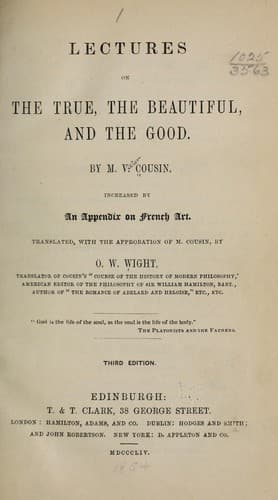
Lectures on the true, the beautiful and the goodCousin, Victor
Philosophy
Lectures on the true, the beautiful and the good
Cousin, Victor
Aesthetics; Ethics; Truth
Man was not made to be a sublime slave, like Epictetus, employed in
supporting bad fortune well without trying to surmount it, nor, like the
author of the _Imitation_, the angelic inhabitant of a cloister, calling
for death as a fortunate deliverance, and anticipating it, as far as in
him lies, by continual penitence and in mute adoration. The love of
pleasure, even the passions, have a place among the needs of humanity.
Suppress the passions, and it is true there is no more excess; neither
is there any mainspring of action,--without winds the vessel no longer
proceeds, and soon sinks in the deep. Suppose a being that lacks love
of self, the instinct of preservation, the horror of suffering,
especially the horror of death, who has neither the love of pleasure nor
the love of happiness, in a word, destitute of all personal
interest,--such a being will not long resist the innumerable causes of
destruction that surround and besiege him; he will not remain a day.
Never can a single family, nor the least society be formed or
maintained. He who has made man has not confided the care of his work to
virtue alone, to devotedness and sublime charity,--he has willed that
the duration and development of the race and human society should be
placed upon simpler and surer foundations; and this is the reason why he
has given to man the love of self, the instinct of preservation, the
taste of pleasure and happiness, the passions that animate life, hope
and fear, love, ambition, personal interest, in fine, a powerful,
permanent, universal motive that urges us on to continually ameliorate
our condition upon the earth.
So we do not contest with the ethics of interest the reality of their
principle,--we are convinced that this principle exists, that it has a
right to be. The only question that we raise is the following:--The
principle of interest is true in itself, but are there not other
principles quite as true, quite as real? Man seeks pleasure and
happiness, but are there not in him other needs, other sentiments as
powerful, as vital? The first and universal principle of human life is
the need of the individual to preserve himself; but would this principle
suffice to support human life and society entire and as we behold it?
Just as the existence of the body does not hinder that of the soul, and
reciprocally, so in the ample bosom of humanity and the profound designs
of divine Providence, the principles that differ most do not exclude
each other.
Public-domain text, read in full here on John Shaqi.
Reviews
Reviews
No reviews yet
Be the first to share your thoughts on this work.
Elsewhere in the archive
Join the Discussion
Join the discussion
Sign in to leave a comment or review.
Sign InorCreate an account