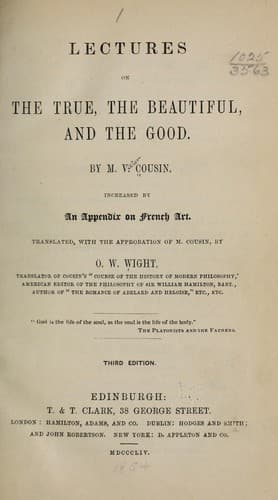
Lectures on the true, the beautiful and the goodCousin, Victor
Philosophy
Lectures on the true, the beautiful and the good
Cousin, Victor
Aesthetics; Ethics; Truth
The ethics of interest are nothing else than the ethics of perfected
pleasure, substituting happiness for pleasure, the useful for the
agreeable, prudence for passion. It admits, like the human race, the
words good and evil, virtue and vice, merit and demerit, punishment and
reward, but it explains them in its own way. The good is that which in
the eyes of reason is conformed to our true interest; evil is that which
is contrary to our true interest. Virtue is that wisdom which knows how
to resist the enticement of passions, discerns what is truly useful, and
surely proceeds to happiness. Vice is that aberration of mind and
character that sacrifices happiness to pleasures without duration or
full of dangers. Merit and demerit, punishment and reward, are the
consequences of virtue and vice:--for not knowing how to seek happiness
by the road of wisdom, we are punished by not attaining it. The ethics
of interest do not pretend to destroy any of the duties consecrated by
public opinion; it establishes that all are conformed to our personal
interest, and it is thereby that they are duties. To do good to men is
the surest means of making them do good to us; and it is also the means
of acquiring their esteem, their good will, and their sympathy,--always
agreeable, and often useful. Disinterestedness itself has its
explanation. Doubtless there is no disinterestedness in the vulgar sense
of the word, that is to say, a real sacrifice of self, which is absurd,
but there is the sacrifice of present interest to future interest, of
gross and sensual passion to a nobler and more delicate pleasure.
Sometimes one renders to himself a bad account of the pleasure that he
pursues, and in fault of seeing clearly into his own heart, invents that
chimera of disinterestedness of which human nature is incapable, which
it cannot even comprehend.
It will be conceded that this explanation of the ethics of interest is
not overcharged, that it is faithful.
We go further,--we acknowledge that these ethics are an extreme, but, up
to a certain point, a legitimate reaction against the excessive rigor of
stoical ethics, especially ascetic ethics that smother sensibility
instead of regulating it, and, in order to save the soul from passions,
demands of it a sacrifice of all the passions of nature that resembles a
suicide.
Public-domain text, read in full here on John Shaqi.
Reviews
Reviews
No reviews yet
Be the first to share your thoughts on this work.
Elsewhere in the archive
Join the Discussion
Join the discussion
Sign in to leave a comment or review.
Sign InorCreate an account