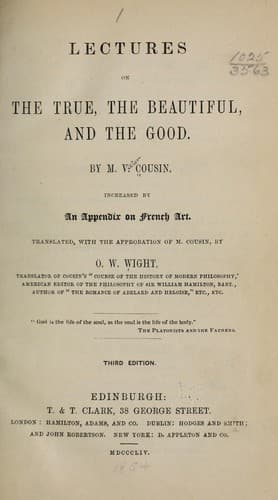
Lectures on the true, the beautiful and the goodCousin, Victor
Philosophy
Lectures on the true, the beautiful and the good
Cousin, Victor
Aesthetics; Ethics; Truth
When an agreeable sensation, after having charmed our soul, quits it and
vanishes, the soul experiences a sort of suffering, a want, a need,--it
is agitated, disquieted. This disquietude, at first vague and
indecisive, is soon determined; it is borne towards the object that has
pleased us, whose absence makes us suffer. This movement of the soul,
more or less vivid, is desire.
Is there in desire any of the characters of liberty? What is it called
to be free? Each one knows that he is free, when he knows that he is
master of his action, that he can begin it, arrest it, or continue it as
he pleases. We are free, when before acting we have taken the resolution
to act, knowing well that we are able to take the opposite resolution. A
free act is that of which, by the infallible testimony of my
consciousness, I know that I am the cause, for which, therefore, I
regard myself as responsible. God, the world, the body, can produce in
me a thousand movements; these movements may seem to the eyes of an
external observer to be voluntary acts; but any error is impossible to
consciousness,--it distinguishes every movement not voluntary, whatever
it may be, from a voluntary act.
True activity is voluntary and free activity. Desire is just the
opposite. Desire, carried to its culmination, is passion; but language,
as well as consciousness, says that man is passive in passion; and the
more vivid passion is, the more imperative are its movements, the
farther is it from the type of true activity in which the soul possesses
and governs itself.
I am no more free in desire than in the sensation that precedes and
determines it. If an agreeable object is presented to me, am I able not
to be agreeably moved? If it is a painful object, am I able not to be
painfully moved? And so, when this agreeable sensation has disappeared,
if memory and imagination remind me of it, is it in my power not to
suffer from no longer experiencing it, is it in my power not to feel the
need of experiencing it again, and to desire more or less ardently the
object that alone can appease the disquietude and suffering of my soul?
Observe well what takes place within you in desire; you recognize in it
a blind emotion, that, without any deliberation on your part, and
without the intervention of your will, rises or falls, increases or
diminishes. One does not desire, and cease to desire, according to his
will.
Will often combats desire, as it often also yields to it; it is not,
therefore, desire. We do not reproach the sensations that objects
produce, nor even the desires that these sensations engender; we do
reproach ourselves for the consent of the will to these desires, and the
acts that follow, for these acts are in our power.
Public-domain text, read in full here on John Shaqi.
Reviews
Reviews
No reviews yet
Be the first to share your thoughts on this work.
Elsewhere in the archive
Join the Discussion
Join the discussion
Sign in to leave a comment or review.
Sign InorCreate an account