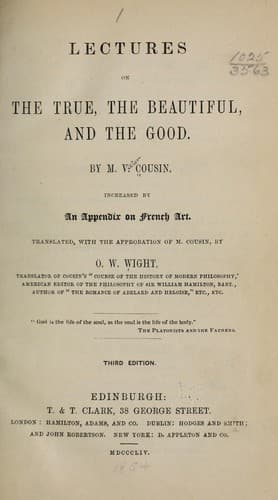
Lectures on the true, the beautiful and the goodCousin, Victor
Philosophy
Lectures on the true, the beautiful and the good
Cousin, Victor
Aesthetics; Ethics; Truth
Desire is so little will, that it often abolishes it, and leads man into
acts that he does not impute to himself, for they are not voluntary. It
is even the refuge of many of the accused; they lay their faults to the
violence of desire and passion, which have not left them masters of
themselves.
If desire were the basis of will, the stronger the desire the freer we
should be. Evidently the contrary is true. As the violence of desire
increases, the dominion of man over himself decreases; and as desire is
weakened and passion extinguished, man repossesses himself.
I do not say that we have no influence over our desires. That two facts
differ, it does not follow that they must be without relation to each
other. By removing certain objects, or even by merely diverting our
thoughts away from the pleasure that they can give us, we are able, to a
certain extent, to turn aside and elude the sensible effects of these
objects, and escape the desire which they might excite in us. One may
also, by surrounding himself with certain objects, in some sort manage
himself, and produce in himself sensations and desires which for that
are not more voluntary than would be the impression made upon us by a
stone with which we should strike ourselves. By yielding to these
desires, we lend them a new force, and we moderate them by a skilful
resistance. One even has some power over the organs of the body, and, by
applying to them an appropriate regimen, he goes so far as to modify
their functions. All this proves that there is in us a power different
from the senses and desire, which, without disposing of them, sometimes
exercises over them an indirect authority.
Will also directs intelligence, although it is not intelligence. To will
and to know are two things essentially different. We do not judge as we
will, but according to the necessary laws of the judgment and the
understanding. The knowledge of truth is not a resolution of the will.
It is not the will that declares, for example, that body is extended,
that it is in space, that every phenomenon has a cause, etc. Yet the
will has much power over intelligence. It is freely and voluntarily that
we work, that we give attention, for a longer or a shorter time, more or
less intense, to certain things; consequently, it is the will that
develops and increases intelligence, as it might let it languish and
become extinguished. It must, then, be avowed that there is in us a
supreme power that presides over all our faculties, over intelligence as
well as sensibility, which is distinguished from them, and is mingled
with them, governs them, or leaves them to their natural development,
making appear, even in its absence, the character that belongs to it,
since the man that is deprived of it avows that he is no longer master
of himself, that he is not himself, so true is it that human personality
resides particularly in that prominent power that is called the
will.[193]
Public-domain text, read in full here on John Shaqi.
Reviews
Reviews
No reviews yet
Be the first to share your thoughts on this work.
Elsewhere in the archive
Join the Discussion
Join the discussion
Sign in to leave a comment or review.
Sign InorCreate an account