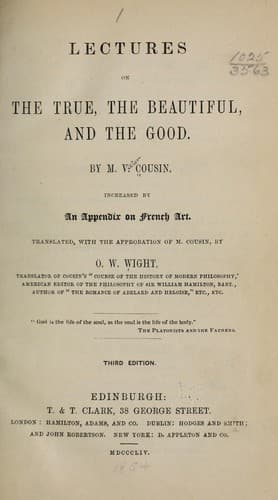
Lectures on the true, the beautiful and the goodCousin, Victor
Philosophy
Lectures on the true, the beautiful and the good
Cousin, Victor
Aesthetics; Ethics; Truth
It is not so with obligation. It exists not, or it is absolute. The idea
of obligation implies that of something inflexible. That alone is a duty
from which one cannot be loosed under any pretext, and is, by the same
title, a duty for all. There is one thing before which all the caprices
of my mind, of my imagination, of my sensibility must disappear,--the
idea of the good with the obligation which it involves. To this supreme
command I can oppose neither my humor, nor circumstances, nor even
difficulties. This law admits of no delay, no accommodation, no excuse.
When it speaks, be it to you or me, in whatever place, under whatever
circumstance, in whatever disposition we may be, it only remains for us
to obey. We are able not to obey, for we are free; but every
disobedience to the law appears to ourselves a fault more or less grave,
a bad use of our liberty. And the violated law has its immediate penal
sanction in the remorse that it inflicts upon us.
The only penalty that is brought upon us by the counsels of prudence,
comprehended more or less well, followed more or less well, is, in the
final account, more or less happiness or unhappiness. Now I pray you, am
I obligated to be happy? Can obligation depend upon happiness, that is
to say, on a thing that it is equally impossible for me to always seek
and obtain at will? If I am obligated, it must be in my power to fulfil
the obligation imposed. But my liberty has but little power over my
happiness, which depends upon a thousand circumstances independent of
me, whilst it is all in all in regard to virtue, for virtue is only an
employment of liberty. Moreover, happiness is in itself, morally,
neither better nor worse than unhappiness. If I understand my interest
badly, I am punished for it by regret, not by remorse. Unhappiness can
overwhelm me; it does not disgrace me, if it is not the consequence of
some vice of the soul.
Not that I would renew stoicism and say to suffering, Thou art no evil.
No, I earnestly advise man to escape suffering as much as he can, to
understand well his interest, to shun unhappiness and seek happiness. I
only wish to establish that happiness is one thing and virtue another,
that man necessarily aspires after happiness, but that he is only
obligated to virtue, and that consequently, by the side of and above
interest well understood is a moral law, that is to say, as
consciousness attests, and the whole human race avows, an imperative
prescription of which one cannot voluntarily divest himself without
crime and shame.
4th. If interest does not account for the idea of duty, by a necessary
consequence, it does not more account for that of right; for duty and
right reciprocally suppose each other.
Public-domain text, read in full here on John Shaqi.
Reviews
Reviews
No reviews yet
Be the first to share your thoughts on this work.
Elsewhere in the archive
Join the Discussion
Join the discussion
Sign in to leave a comment or review.
Sign InorCreate an account