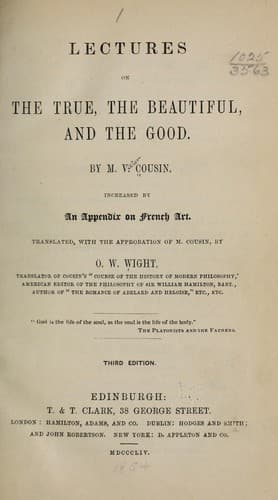
Lectures on the true, the beautiful and the goodCousin, Victor
Philosophy
Lectures on the true, the beautiful and the good
Cousin, Victor
Aesthetics; Ethics; Truth
It is at first very evident that obligation supposes a being capable of
fulfilling it, that duty is applied only to a free being. Then the
nature of obligation is such, that if we are delinquent in fulfilling
it, we feel ourselves culpable, whilst if, instead of understanding our
interest well, we have understood it ill, there follows only a single
thing, that we are unfortunate. Are, then, being culpable and being
unfortunate the same thing? These are two ideas radically different. You
may advise me to understand my interest well, under penalty of falling
into misfortune; you cannot command me to see clearly in regard to my
interest under penalty of crime.
Imprudence has never been considered a crime. When it is morally
accused, it is much less as being wrong than as attesting vices of the
soul, lightness, presumption, feebleness.
As we have said, our true interest is often most difficult of
discernment. Obligation is always immediate and manifest. In vain
passion and desire combat it; in vain the reasoning that passion trains
for its attendance, like a docile slave, tries to smother it under a
mass of sophisms: the instinct of conscience, a cry of the soul, an
intuition of reason, different from reasoning, is sufficient to repel
all sophisms, and make obligation appear.
However pressing may be the solicitations of interest, we may always
enter into contest and arrangement with it. There are a thousand ways of
being happy. You assure me that, by conducting myself in such a manner,
I shall arrive at fortune. Yes, but I love repose more than fortune, and
with happiness alone in view, activity is not better than sloth. Nothing
is more difficult than to advise any one in regard to his interest,
nothing is easier than to advise him in regard to honor.
After all, in practice, the useful is resolved into the agreeable, that
is to say, into pleasure. Now, in regard to pleasure, every thing
depends on humor and temperament. When there is neither good nor evil in
itself, there are no pleasures more or less noble, more or less
elevated; there are only pleasures that are more or less agreeable to
us. Every thing depends on the nature of each one. This is the reason
why interest is so capricious. Each one understands it as it pleases
him, because each one is the judge of what pleases him. One is more
moved by pleasures of the senses; another by pleasures of mind and
heart. To the latter, the passion of glory takes the place of pleasures
of the senses; to the former, the pleasure of dominion appears much
superior to that of glory. Each man has his own passions, each man,
then, has his own way of understanding his interest; and even my
interest of to-day is not my interest of to-morrow. The revolutions of
health, age, and events greatly modify our tastes, our humors. We are
ourselves perpetually changing, and with us change our desires and our
interests.
Public-domain text, read in full here on John Shaqi.
Reviews
Reviews
No reviews yet
Be the first to share your thoughts on this work.
Elsewhere in the archive
Join the Discussion
Join the discussion
Sign in to leave a comment or review.
Sign InorCreate an account