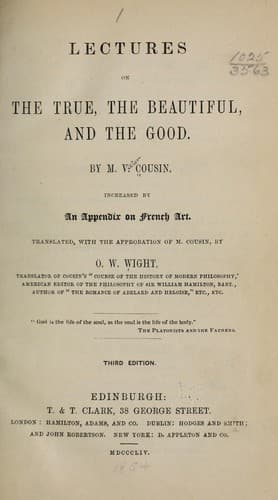
Lectures on the true, the beautiful and the goodCousin, Victor
Philosophy
Lectures on the true, the beautiful and the good
Cousin, Victor
Aesthetics; Ethics; Truth
has made, and that it is not in the power of man not only to efface, but
even to modify. Noble liberty has nothing to settle with the furies of
pride and envy. As it does not aspire to domination, so, and by virtue
of the same principle, it does not more aspire to a chimerical equality
of mind, of beauty, of fortune, of enjoyments. Moreover, such an
equality, were it possible, would be of little value in its own eyes; it
asks something much greater than pleasure, fortune, rank, to wit,
respect. Respect, an equal respect of the sacred right of being free in
every thing that constitutes the person, that person which is truly man;
this is what liberty and with it true equality claim, or rather
imperatively demand. Respect must not be confounded with homage. I
render homage to genius and beauty. I respect humanity alone, and by
that I mean all free natures, for every thing that is not free in man is
foreign to him. Man is therefore the equal of man precisely in every
thing that makes him man, and the reign of true equality exacts on the
part of all only the same respect for what each one possesses equally in
himself, both young and old, both ugly and beautiful, both rich and
poor, both the man of genius and the mediocre man, both woman and man,
whatever has consciousness of being a person and not a thing. The equal
respect of common liberty is the principle at once of duty and right; it
is the virtue of each and the security of all; by an admirable
agreement, it is dignity among men, and accordingly peace on earth. Such
is the great and holy image of liberty and equality, which has made the
hearts of our fathers beat, and the hearts of all virtuous and
enlightened men, of all true friends of humanity. Such is the ideal that
true philosophy pursues across the ages, from the generous dreams of
Plato to the solid conceptions of Montesquieu, from the first free
legislation of the smallest city of Greece to our declaration of rights,
and the immortal works of the constituent Assembly.
Public-domain text, read in full here on John Shaqi.
Reviews
Reviews
No reviews yet
Be the first to share your thoughts on this work.
Elsewhere in the archive
Join the Discussion
Join the discussion
Sign in to leave a comment or review.
Sign InorCreate an account