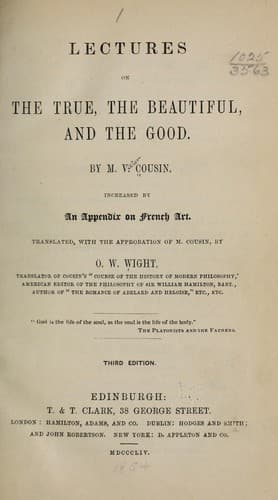
Lectures on the true, the beautiful and the goodCousin, Victor
Philosophy
Lectures on the true, the beautiful and the good
Cousin, Victor
Aesthetics; Ethics; Truth
The philosophy of sensation starts with a principle that condemns it to
consequences as disastrous as those of the principle of liberty are
beneficent. By confounding will with desire, it justifies passion, which
is desire in all its force--passion, which is precisely the opposite of
liberty. It accordingly unchains all the desires and all the passions,
it gives full rein to imagination and the heart; it renders each man
much less happy on account of what he possesses, than miserable on
account of what he lacks; it makes him regard his neighbors with an eye
of envy and contempt, and continually pushes society towards anarchy or
tyranny. Whither, in fact, would you have interest lead in the train of
desire? My desire is certainly to be the most fortunate possible. My
interest is to seek to be so by all means, whatever they may be, under
the single reserve that they be not contrary to their end. If I am born
the first of men, the richest, the most beautiful, the most powerful,
etc., I shall do every thing to preserve the advantages I have received.
If fate has given me birth in a rank little elevated, with a moderate
fortune, limited talents, and immense desires--for it cannot too often
be repeated, desire of every kind aspires after the infinite--I shall do
every thing to rise above the crowd, in order to increase my power, my
fortune, my joys. Unfortunate on account of my position in this world,
in order to change it, I dream of, and call for revolutions, it is true,
without enthusiasm and political fanaticism, for interest alone does not
produce these noble follies, but under the sharp goad of vanity and
ambition. Thereby, then, I arrive at fortune and power; interest, then,
claims security, as before it invoked agitation. The need of security
brings me back from anarchy to the need of order, provided order be to
my profit; and I become a tyrant, if I can, or the gilt servant of a
tyrant. Against anarchy and tyranny, those two scourges of liberty, the
only rampart is the universal sentiment of right, founded on the firm
distinction between good and evil, the just and the useful, the honest
and the agreeable, virtue and interest, will and desire, sensation and
conscience.
5. Let us again signalize one of the necessary consequences of the
doctrine of interest.
Public-domain text, read in full here on John Shaqi.
Reviews
Reviews
No reviews yet
Be the first to share your thoughts on this work.
Elsewhere in the archive
Join the Discussion
Join the discussion
Sign in to leave a comment or review.
Sign InorCreate an account