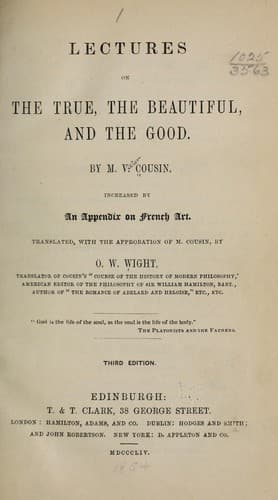
Lectures on the true, the beautiful and the goodCousin, Victor
Philosophy
Lectures on the true, the beautiful and the good
Cousin, Victor
Aesthetics; Ethics; Truth
A free being, in possession of the sacred rule of justice, cannot
violate it, knowing that he should and may follow it, without
immediately recognizing that he merits punishment. The idea of
punishment is not an artificial idea, borrowed from the profound
calculations of legislators; legislations rest upon the natural idea of
punishment. This idea, corresponding to that of liberty and justice, is
necessarily wanting where the former two do not exist. Does he who
obeys, and fatally obeys his desires, by the attraction of pleasure and
happiness, supposing that, without any other motive than that of
interest, he does an act conformed, externally at least, to the rule of
justice, merit any thing by doing such an action? Not the least in the
world. Conscience attributes to him no merit, and no one owes him thanks
or recompense, for he only thinks of himself. On the other hand, if he
injures others in wishing to serve himself, he does not feel culpable,
and no one can say to him that he has merited punishment. A free being
who wills what he does, who has a law, and can conform to it, or break
it, is alone responsible for his acts. But what responsibility can there
be in the absence of liberty and a recognized and accepted rule of
justice? The man of sensation and desire tends to his own good under the
law of interest, as the stone is drawn towards the centre of the earth
under the law of gravitation, as the needle points to the pole. Man may
err in the pursuit of his interest. In this case, what is to be done!
As it seems, to put him again in the right way. Instead of that, he is
punished. And for what, I pray you? For being deceived. But error merits
advice, not punishment. Punishment has, in the system of interest, no
more the sanction of moral sense than recompense. Punishment is only an
act of personal defence on the part of society; it is an example which
it gives, in order to inspire a salutary terror. These motives are
excellent, if it be added that this punishment is just in itself, that
it is merited, and that it is legitimately applied to the action
committed. Omit that, and the other motives lose their authority, and
there remains only an exercise of force, destitute of all morality. Then
the culprit is not punished; he is smitten, or even put to death, as the
animal that injures instead of serving is put to death without scruple.
The condemned does not bow his head to the wholesome reparation due to
justice, but to the weight of irons or the stroke of the axe. The
chastisement is not a legitimate satisfaction, an expiation which,
comprehended by the culprit, reconciles him in his own eyes with the
order that he has violated. It is a storm that he could not escape; it
is the thunder-bolt that falls upon him; it is a force more powerful
than his own, which compasses and overthrows him. The appearance of
public chastisements acts, without doubt, upon the imagination of
peoples; but it does not enlighten their reason and speak to their
Public-domain text, read in full here on John Shaqi.
Reviews
Reviews
No reviews yet
Be the first to share your thoughts on this work.
Elsewhere in the archive
Join the Discussion
Join the discussion
Sign in to leave a comment or review.
Sign InorCreate an account