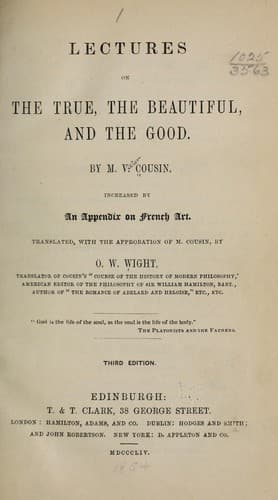
Lectures on the true, the beautiful and the goodCousin, Victor
Philosophy
Lectures on the true, the beautiful and the good
Cousin, Victor
Aesthetics; Ethics; Truth
What holy hope could we then found upon such a God? And we who have some
time grovelled upon this earth, thinking only of ourselves, seeking only
pleasure and a pitiable happiness, what sufferings nobly borne for
justice, what generous efforts to maintain and develop the dignity of
our soul, what virtuous affections for other souls, can we offer to the
Father of humanity as titles to his merciful justice? The principle that
most persuades the human race of the immortality of the soul is still
the necessary principle of merit and demerit, which, not finding here
below its exact satisfaction, and yet under the necessity of finding it,
inspires us to call upon God for its satisfaction, who has not put in
our hearts the law of justice to violate it himself in regard to
us.[199] Now, we have just seen that the ethics of interest destroy the
principle of merit and demerit, both in this world, and above all, in
the world to come. Accordingly, there is no regard beyond this
world,--no recourse to an all-powerful judge, wholly just and wholly
good, against the sports of fortune and the imperfections of human
justice. Every thing is completed for man between birth and death, in
spite of the instincts and presentiments of his heart, and even the
principles of his reason.
The disciples of Helvetius will, perhaps, claim the glory of having
freed humanity from the fears and hopes that turn it aside from its true
interests. It is a service which mankind will appreciate. But since they
confine our whole destiny to this world, let us demand of them what lot
so worthy of envy they have in reserve for us here, what social order
they charge with our good fortune, what politics, in fine, are derived
from their ethics.[200]
You already know. We have demonstrated that the philosophy of sensation
knows neither true liberty nor true right. What, in fact, is will for
this philosophy? It is desire. What, then, is right? The power of
satisfying desires. On this score, man is not free, and right is might.
Public-domain text, read in full here on John Shaqi.
Reviews
Reviews
No reviews yet
Be the first to share your thoughts on this work.
Elsewhere in the archive
Join the Discussion
Join the discussion
Sign in to leave a comment or review.
Sign InorCreate an account