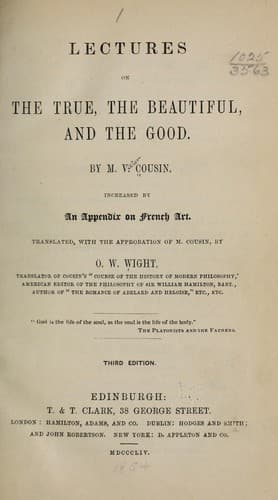
Lectures on the true, the beautiful and the goodCousin, Victor
Philosophy
Lectures on the true, the beautiful and the good
Cousin, Victor
Aesthetics; Ethics; Truth
Once more, nothing pertains less to man than desire. Desire comes of
need which man does not make, which he submits to. He submits in the
same way to desire. To reduce will to desire is to annihilate liberty;
it is worse still, it is to put it where it is not; it is to create a
mendacious liberty that becomes an instrument of crime and misery. To
call man to such a liberty is to open his soul to infinite desires,
which it is impossible for him to satisfy. Desire is in its nature
without limits, and our power is very limited. If we were alone in this
world, we should even then be much troubled to satisfy our desires. But
we press against each other with immense desires, and limited, diverse,
and unequal powers. When right is the force that is in each of us,
equality of rights is a chimera,--all rights are unequal, since all
forces are unequal and can never cease to be so. It is, therefore,
necessary to renounce equality as well as liberty; or if one invents a
false equality as well as a false liberty, he puts humanity in pursuit
of a phantom.
Such are the social elements that the ethics of interest give to
politics. From such elements I defy all the politics of the school of
sensation and interest to produce a single day of liberty and happiness
for the human race.
When right is might, the natural state of men among themselves, is war.
All desiring the same things, they are all necessarily enemies; and in
this war, woe to the feeble, to the feeble in body and the feeble in
mind! The stronger are the masters by perfect right. Since right is
might, the feeble may complain of nature that has not made them strong,
and not complain of the strong man who uses his right in oppressing
them. The feeble then call deception to their aid; and it is in this
strife between cunning and force that humanity combats with itself.
Yes, if there are only needs, desires, passions, interests, with
different forces pitted against each other, war, a war sometimes
declared and bloody, sometimes silent and full of meannesses, is in the
nature of things. No social art can change this nature,--it may be more
or less covered; it always reappears, overcomes and rends the veil with
which a mendacious legislation envelops it. Dream, then, of liberty for
beings that are not free, of equality between beings that are
essentially different, of respect for rights where there is no right,
and of the establishment of justice on an indestructible foundation of
inimical passions! From such a foundation can spring only endless
troubles or oppression, or rather all these evils together in a
necessary circle.
Public-domain text, read in full here on John Shaqi.
Reviews
Reviews
No reviews yet
Be the first to share your thoughts on this work.
Elsewhere in the archive
Join the Discussion
Join the discussion
Sign in to leave a comment or review.
Sign InorCreate an account