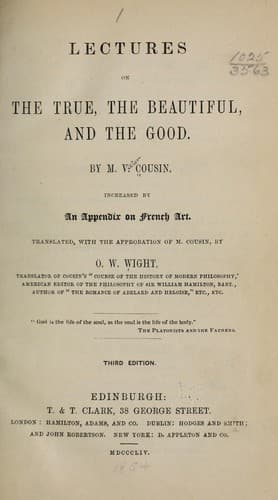
Lectures on the true, the beautiful and the goodCousin, Victor
Philosophy
Lectures on the true, the beautiful and the good
Cousin, Victor
Aesthetics; Ethics; Truth
This fatal circle can be broken only by the aid of principles which all
the metamorphoses of sensation do not engender, and for which interest
cannot account, which none the less subsist to the honor and for the
safety of humanity. These principles are those that time has little by
little drawn from Christianity in order to give them for the guidance of
modern societies. You will find them written in the glorious declaration
of rights that forever broke the monarchy of Louis XV., and prepared the
constitutional monarchy. They are in the charter that governs us, in our
laws, in our institutions, in our manners, in the air that we breathe.
They serve at once as foundations for our society and the new philosophy
necessary to a new order.[201]
Perhaps you will ask me how, in the eighteenth century, so many
distinguished, so many honest souls could let themselves be seduced by a
system that must have been revolting to all their sentiments. I will
answer by reminding you that the eighteenth century was an immoderate
reaction against the faults into which had sadly fallen the old age of a
great century and a great king, that is to say, the revocation of the
edict of Nantes, the persecution of all free and elevated philosophy, a
narrow and suspicious devotion, and intolerance, with its usual
companion, hypocrisy. These excesses must have produced opposite
excesses. Mme. de Maintenon opened the route to Mme. de Pompadour. After
the mode of devotion comes that of license; it takes every thing by
storm. It descends from the court to the nobility, to the clergy even,
and accordingly to the people. It carried away the best spirits, even
genius itself. It put a foreign philosophy in the place of the national
philosophy, culpable, persecuted as it had been, for not being
irreconcilable with Christianity. A disciple of Locke, whom Locke had
discarded, Condillac, took the place of Descartes, as the author of
_Candide_ and _la Pucelle_ had taken the place of Corneille and Bossuet,
as Boucher and Vanloo had taken the place of Lesueur and Poussin. The
ethics of pleasure and interest were the necessary ethics of that epoch.
It must not be supposed from this that all souls were corrupt. Men, says
M. Royer-Collard, are neither as good nor as bad as their
principles[202]. No stoic has been as austere as stoicism, no epicurean
as enervated as epicureanism. Human weakness practically baffles
virtuous theories; in return, thank God, the instinct of the heart
condemns to inconsistency the honest man who errs in bad theories.
Accordingly, in the eighteenth century, the most generous and most
disinterested sentiments often shone forth under the reign of the
philosophy of sensation and the ethics of interest. But it is none the
less true, that the philosophy of sensation is false, and the ethics of
interest destructive of all morality.
Public-domain text, read in full here on John Shaqi.
Reviews
Reviews
No reviews yet
Be the first to share your thoughts on this work.
Elsewhere in the archive
Join the Discussion
Join the discussion
Sign in to leave a comment or review.
Sign InorCreate an account