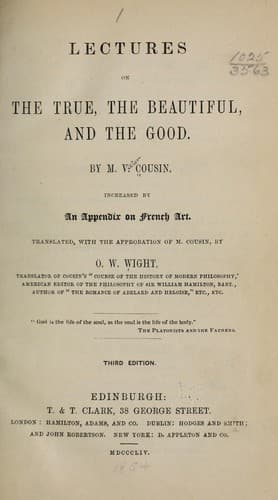
Lectures on the true, the beautiful and the goodCousin, Victor
Philosophy
Lectures on the true, the beautiful and the good
Cousin, Victor
Aesthetics; Ethics; Truth
The ethics of egoism are only a perpetual falsehood,--they preserve the
names consecrated by ethics, but they abolish ethics themselves; they
deceive humanity by speaking to humanity its own language, concealing
under this borrowed language a radical opposition to all the instincts,
to all the ideas that form the treasure of mankind. On the contrary, if
sentiment is not the good itself, it is its faithful companion and
useful auxiliary. It is as it were the sign of the presence of the good,
and renders the accomplishment of it more easy. We always have sophisms
at our disposal, in order to persuade ourselves that our true interest
is to satisfy present passion; but sophism has less influence over the
mind when the mind is in some sort defended by the heart. Nothing is,
therefore, more salutary than to excite and preserve in the soul those
noble sentiments that lift us above the slavery of personal interest.
The habit of participating in the sentiments of virtuous men disposes us
to act like them. To cultivate in ourselves benevolence and sympathy is
to fertilize the source of charity and love, is to nourish and develop
the germ of generosity and devotion.
It is seen that we render sincere homage to the ethics of sentiment.
These ethics are true,--only they are not sufficient for themselves;
they need a principle which authorizes them.
I act well, and I feel on account of it an internal satisfaction: I do
evil, and feel remorse on account of it. These two sentiments do not
qualify the act that I have just done, since they follow it. Would it be
possible for us to feel any internal satisfaction for having acted well
if we did not judge that we had acted well?--any remorse for having
done evil, if we did not judge that we had done evil? At the same time
that we do such or such an act, a natural and instinctive judgment
characterizes it, and it is in consequence of this judgment that our
sensibility is moved. Sentiment is not this primitive and immediate
judgment; far from forming the basis of the idea of the good, it
supposes it. It is manifestly a vicious circle to derive the knowledge
of the good from that which would not exist without this knowledge.[204]
Public-domain text, read in full here on John Shaqi.
Reviews
Reviews
No reviews yet
Be the first to share your thoughts on this work.
Elsewhere in the archive
Join the Discussion
Join the discussion
Sign in to leave a comment or review.
Sign InorCreate an account