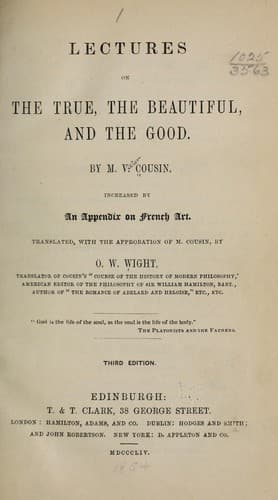
Lectures on the true, the beautiful and the goodCousin, Victor
Philosophy
Lectures on the true, the beautiful and the good
Cousin, Victor
Aesthetics; Ethics; Truth
So is it not because we find a good action that we sympathize with it?
Is it not because the dispositions of a man appear to us conformed to
the idea of justice, that we are inclined to participate in them with
him? Moreover, if sympathy were the true criterion of the good, every
thing for which we feel sympathy would be good. But sympathy is not only
related to things in their nature moral, we also sympathize with the
grief and the joy that have nothing to do with virtue and crime. We even
sympathize with physical sufferings. Moral sympathy is only a case of
general sympathy. It must even be acknowledged that sympathy is not
always in accordance with right. We sometimes sympathize with certain
sentiments that we condemn, because, without being in themselves
bad--which would prevent all sympathy--they give an inclination to the
greatest faults; for example, love, which comes so near to irregularity,
and emulation, that so quickly leads to ambition.
Benevolence also is not always determined by the good alone. And, again,
when it is applied to a virtuous man, it supposes a judgment by which we
pronounce that this man is virtuous. It is not because we wish the
author of an action well that we judge that this action is good; it is
because we judge that this action is good that we wish its author well.
This is not all. In the sentiment of benevolence is enveloped a new
judgment which is not in sympathy. This judgment is the following: the
author of a good action deserves to be happy, as the author of a bad
action deserves to suffer in order to expiate it. This is the reason why
we desire happiness for the one and reparatory suffering for the other.
Benevolence is little else than the sensible form of this judgment.
All these sentiments, therefore, suppose an anterior and superior
judgment. Everywhere and always the same vicious circle. From the fact
that the sentiments which we have just described have a moral character,
it is concluded that they constitute the idea of the good, whilst it is
the idea of the good that communicates to them the character that we
perceive in them.
Public-domain text, read in full here on John Shaqi.
Reviews
Reviews
No reviews yet
Be the first to share your thoughts on this work.
Elsewhere in the archive
Join the Discussion
Join the discussion
Sign in to leave a comment or review.
Sign InorCreate an account