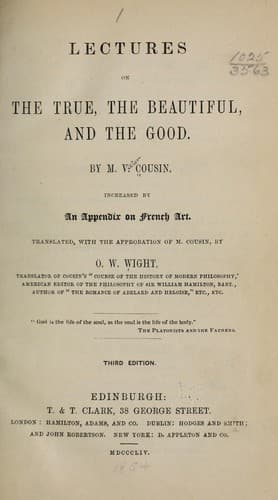
Lectures on the true, the beautiful and the goodCousin, Victor
Philosophy
Lectures on the true, the beautiful and the good
Cousin, Victor
Aesthetics; Ethics; Truth
Is it not a rule of prudence not to listen to, without always disdaining
them, the inspirations--often capricious--of the heart? Governed by
reason, sentiment becomes to it an admirable support. But, delivered up
to itself, in a little while it degenerates into passion, and passion is
fantastic, excessive, unjust; it gives to the soul spring and energy,
but generally troubles and perverts it. It is even not very far from
egoism, and it usually terminates in that, wholly generous as it is or
seems to be in the beginning. Unless we always keep in sight the good
and the inflexible obligation that is attached to it, unless we always
keep in sight this fixed and immutable point, the soul knows not where
to betake itself on that moving ground that is called sensibility; it
floats from sentiment to passion, from generosity to selfishness,
ascending one day to the pitch of enthusiasm, and the next day
descending to all the miseries of personality.
Thus the ethics of sentiment, although superior to those of interest,
are not less insufficient: 1st. They give as the foundation of the idea
of the good what is founded on this same idea; 2d. The rule that they
propose is too mobile to be universally obligatory.[205]
There is another system of which I will also say, as of the preceding,
that it is not false, but incomplete and insufficient.
The partisans of the ethics of utility and happiness have tried to save
their principle by generalizing it. According to them, the good can be
nothing but happiness; but egoism is wrong in understanding by that the
happiness of the individual; we must understand by it the general
happiness.
Let us establish, in the first place, that the new principle is entirely
opposed to that of personal interest, for, according to circumstances,
it may demand, not only a passing sacrifice, but an irreparable
sacrifice, that of life. Now, the wisest calculations of personal
interest cannot go thus far.
And, notwithstanding, this principle is far from containing true ethics
and the whole of ethics.
Public-domain text, read in full here on John Shaqi.
Reviews
Reviews
No reviews yet
Be the first to share your thoughts on this work.
Elsewhere in the archive
Join the Discussion
Join the discussion
Sign in to leave a comment or review.
Sign InorCreate an account