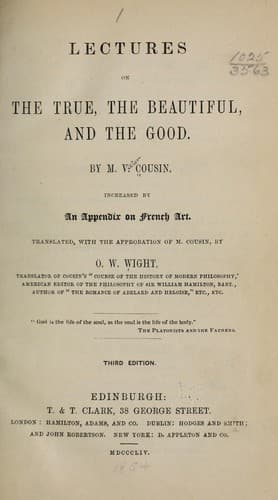
Lectures on the true, the beautiful and the goodCousin, Victor
Philosophy
Lectures on the true, the beautiful and the good
Cousin, Victor
Aesthetics; Ethics; Truth
Another difficulty is, that sentiments pertain to sensibility, and
borrow from it something of its relative and changing nature. It is,
then, very necessary that all men should be made to enjoy with the same
delicacy the pleasures of the heart. There are gross natures and natures
refined. If your desires are impetuous and violent, will not the idea of
the pleasures of virtue be in you much more easily overcome by the force
of passion than if nature had given you a tranquil temperament? The
state of the atmosphere, health, sickness, calm or rouse our moral
sensibility. Solitude, by delivering man up to himself, leaves to
remorse all its energy, the presence of death redoubles it; but the
world, noise, force of example, habit, without power to smother it, in
some sort stun it. The spirit has a little season of rest. We are not
always in the vein of enthusiasm. Courage itself has its intermissions.
We know the celebrated expression: He was one day brave. Humor has its
vicissitudes that influence our most intimate sentiments. The purest,
the most ideal sentiment still pertains on some side to organization.
The inspiration of the poet, the passion of the lover, the enthusiasm of
the martyr, have their languors and shortcomings that often depend on
very pitiable material causes. On those perpetual fluctuations of
sentiment, is it possible to ground a legislation equal for all?
Sympathy and benevolence do not escape the conditions of all the
phenomena of sensibility. We do not all possess in the same degree the
power of feeling what others experience. Those who have suffered most
best comprehend suffering, and consequently feel for it the most lively
compassion. With mere imagination one also represents to himself better
and feels more what passes in the souls of his fellow-man. One feels
more sympathy for physical pleasures and pains, another for pleasures
and pains of soul; and each of these sympathies has in each of us its
degrees and variations. They not only differ, they often oppose each
other. Sympathy for talent weakens the indignation that outraged virtue
produces. We overlook many things in Voltaire, in Rousseau, in Mirabeau,
and we excuse them on account of the corruption of their century. The
sympathy caused by the pain of a condemned person renders less lively
the just antipathy excited by his crime. Thus turns and wavers at each
step that sympathy which some would set up as the supreme arbiter of the
good. Benevolence does not vary less. We have souls naturally more or
less affectionate, more or less animated. And, then, like sympathy,
benevolence receives the counter-stroke of different passions that are
mingled with it. Friendship, for example, often renders us, in spite of
ourselves, more benevolent than justice would wish.
Public-domain text, read in full here on John Shaqi.
Reviews
Reviews
No reviews yet
Be the first to share your thoughts on this work.
Elsewhere in the archive
Join the Discussion
Join the discussion
Sign in to leave a comment or review.
Sign InorCreate an account