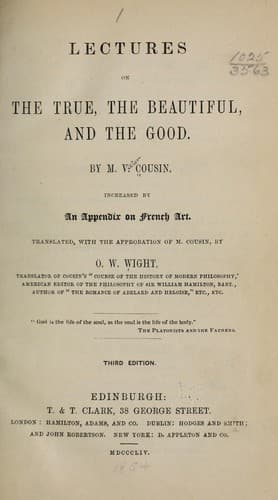
Lectures on the true, the beautiful and the goodCousin, Victor
Philosophy
Lectures on the true, the beautiful and the good
Cousin, Victor
Aesthetics; Ethics; Truth
Another error of this system is that it confounds the good itself with
one of its applications. If the good is the greatest interest of the
greatest number, the consequence is clear, that there are only public
and social ethics, and no private ethics; there is only a single class
of duties, duties towards others, and there are no duties towards
ourselves. But this is retrenching precisely those of our duties that
most surely guarantee the exercise of all the rest.[209] The most
constant relations that I sustain are with that being which is myself.
I am my own most habitual society. I bear in myself, as Plato[210] has
well said, a whole world of ideas, sentiments, desires, passions,
emotions, which claim a legislation. This necessary legislation is
suppressed.
Let us also say a word on a system that, under sublime appearances,
conceals a vicious principle.
There are persons who believe that they are magnifying God, by placing
in his will alone the foundation of the moral law, and the sovereign
motive of humanity in the punishments and rewards that it has pleased
him to attach to the respect and violation of his will.
Let us understand what we are about in a matter of such delicacy.
It is certain, and we shall establish it for the good,[211] as we have
done for the true and the beautiful,[212] it is certain that, from
explanations to explanations, we come to be convinced that God is
definitively the supreme principle of ethics, so that it may be very
truly said, that the good is the expression of his will, since his will
is itself the expression of the eternal and absolute justice that
resides in him. God wills, without doubt, that we should act according
to the law of justice that he has put in our understanding and our
heart; but it is not at all necessary to conclude that he has
arbitrarily instituted this law. Far from that, justice is in the will
of God only because it has its roots in his intelligence and wisdom,
that is to say, in his most intimate nature and essence.
While making, then, every reservation in regard to what is true in the
system that founds ethics on the will of God, we must show what there is
in this system, as it is presented to us, false, arbitrary, and
incompatible with ethics themselves.[213]
Public-domain text, read in full here on John Shaqi.
Reviews
Reviews
No reviews yet
Be the first to share your thoughts on this work.
Elsewhere in the archive
Join the Discussion
Join the discussion
Sign in to leave a comment or review.
Sign InorCreate an account