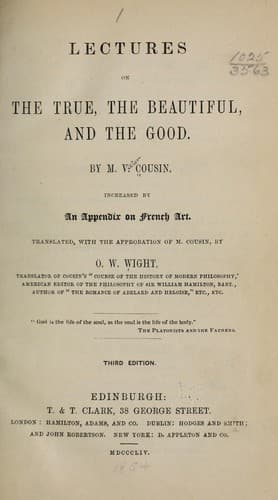
Lectures on the true, the beautiful and the goodCousin, Victor
Philosophy
Lectures on the true, the beautiful and the good
Cousin, Victor
Aesthetics; Ethics; Truth
In the first place, it does not pertain to the will, whatever it may
be, to institute the good, any more than it belongs to it to institute
the true and the beautiful. I have no idea of the will of God except by
my own, to be sure with the differences that separate what is finite
from what is infinite. Now, I cannot by my will found the least truth.
Is it because my will is limited? No; were it armed with infinite power,
it would, in this respect, be equally impotent. Such is the nature of my
will that, in doing a thing, it is conscious of the power to do the
opposite; and that is not an accidental character of the will, it is its
fundamental character; if, then, it is supposed that truth, or that
first part of it which is called justice, has been established as it is
by an act of volition, human or Divine, it must be acknowledged that
another act might have established it otherwise, and made what is now
just unjust, and what is unjust just. But such mobility is contrary to
the nature of justice and truth. In fact, moral truths are as absolute
as metaphysical truths. God cannot make effects exist without a cause,
phenomena without a substance; neither can he make it evil to respect
his word, to love truth, to repress one's passions. The principles of
ethics are immutable axioms like those of geometry. Of moral laws
especially must be said what Montesquieu said of all laws in
general,--they are necessary relations that are derived from the nature
of things.
Let us suppose that the good and the just are derived from the divine
will; on the divine will obligation will also rest. But can any will
whatever be the foundation of obligation? The divine will is the will
of an omnipotent being, and I am a feeble being. This relation of a
feeble being to an omnipotent being, does not contain in itself any
moral idea. One may be forced to obey the stronger, but he is not
obligated to do it. The sovereign orders of the will of God, if his will
could for a moment be separated from his other attributes, would not
contain the least ray of justice; and, consequently, there would not
descend into my soul the least shade of obligation.
One will exclaim,--It is not the arbitrary will of God that makes the
foundation of obligation and justice; it is his just will. Very well.
Every thing changes then. It is not the pure will of God that obligates
us, it is the motive itself that determines his will, that is to say,
the justice passed into his will. The distinction between the just and
the unjust is not then the work of his will.
One of two things. Either we found ethics on the will of God alone, and
then the distinction between good and evil, just and unjust, is
gratuitous, and moral obligation does not exist; or you give authority
to the will of God by justice, which, in your hypothesis, must have
received from the will of God its authority, which is a _petitio
principii_.
Public-domain text, read in full here on John Shaqi.
Reviews
Reviews
No reviews yet
Be the first to share your thoughts on this work.
Elsewhere in the archive
Join the Discussion
Join the discussion
Sign in to leave a comment or review.
Sign InorCreate an account