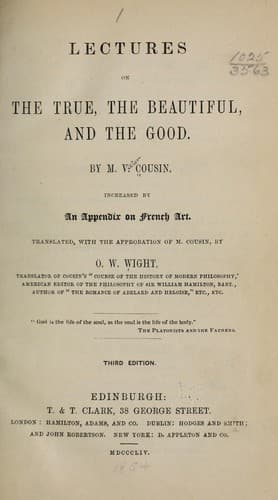
Lectures on the true, the beautiful and the goodCousin, Victor
Philosophy
Lectures on the true, the beautiful and the good
Cousin, Victor
Aesthetics; Ethics; Truth
[213] This polemic is not new. The school of St. Thomas engaged in it
early against the theory of Occam, which was quite similar to that which
we combat. See our _Sketch of a General History of Philosophy_, 2d
Series, vol. ii., lect. 9, _On Scholasticism_. Here are two decisive
passages from St. Thomas, 1st book of the _Summation against the
Gentiles_, chap. lxxxvii: "Per praedicta autem excluditur error dicentiam
omnia procedere a Deo secundum simplicem voluntatem, ut de nullo
oporteat rationem reddere, nisi quia Deus vult. Quod etiam divinae
Scripturae contrariatur, quae Deum perhibet secundum ordinem sapientiae suae
omnia fecisse, secundum illud Psalm ciii.: omnia in sapientia fecisti."
_Ibid._, book ii., chap. xxiv.: "Per hoc autem excluditur quorundam
error qui dicebant omnia ex simplica divina voluntate dependere aliqua
ratione."
[214] See the famous calculus applied to the immortality of the soul,
_Des Pensees de Pascal_, vol. i. of the 4th Series, p. 229-235 and p.
289-296.
[215] Lecture 16.
LECTURE XIV.
TRUE PRINCIPLES OF ETHICS.
Description of the different facts that compose the moral
phenomena.--Analysis of each of these facts:--1st, Judgment and
idea of the good. That this judgment is absolute. Relation
between the true and the good.--2d, Obligation. Refutation of
the doctrine of Kant that draws the idea of the good from
obligation instead of founding obligation on the idea of the
good.--3d, Liberty, and the moral notions attached to the notion
of liberty.--4th, Principle of merit and demerit. Punishments
and rewards.--5th, Moral sentiments.--Harmony of all these facts
in nature and science.
Philosophic criticism is not confined to discerning the errors of
systems; it especially consists in recognizing and disengaging the
truths mixed with these errors. The truths scattered in different
systems compose the whole truth which each of these almost always
expresses on a single side. So, the systems that we have just run over
and refuted deliver up to us, in some sort, divided and opposed to each
other, all the essential elements of human morality. The only question
is to collect them, in order to restore the entire moral phenomenon. The
history of philosophy, thus understood, prepares the way for or confirms
psychological analysis, as psychological analysis receives from the
history of philosophy its light. Let us, then, interrogate ourselves in
presence of human actions, and faithfully collect, without altering them
by any preconceived system, the ideas and the sentiments of every kind
that the spectacle of these actions produce in us.
Public-domain text, read in full here on John Shaqi.
Reviews
Reviews
No reviews yet
Be the first to share your thoughts on this work.
Elsewhere in the archive
Join the Discussion
Join the discussion
Sign in to leave a comment or review.
Sign InorCreate an account