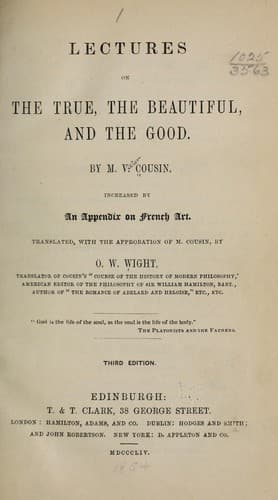
Lectures on the true, the beautiful and the goodCousin, Victor
Philosophy
Lectures on the true, the beautiful and the good
Cousin, Victor
Aesthetics; Ethics; Truth
[207] See lecture 12.
[208] 1st Series, vol. iv., p. 174: "If the good is that alone which
must be the most useful to the greatest number, where can the good be
found, and who can discern it? In order to know whether such an action,
which I propose to myself to do, is good or bad, I must be sure, in
spite of its visible and direct utility in the present moment, that it
will not become injurious in a future that I do not yet know. I must
seek whether, useful to mine and those that surround me, it will not
have counter-strokes disastrous to the human race, of which I must think
before all. It is important that I should know whether the money that I
am tempted to give this unfortunate who needs it, could not be otherwise
more usefully employed, in fact, the rule is here the greatest good of
the greatest number. In order to follow it, what calculations are
imposed on me? In the obscurity of the future, in the uncertainty of the
somewhat remote consequences of every action, the surest way is to do
nothing that is not related to myself, and the last result of a prudence
so refined is indifference and egoism. Supposing you have received a
deposit from an opulent neighbor, who is old and sick, a sum of which he
has no need, and without which your numerous family runs the risk of
dying with famine. He calls on you for this sum,--what will you do? The
greatest number is on your side, and the greatest utility also; for this
sum is insignificant for your rich neighbor, whilst it will save your
family from misery, and perhaps from death. Father of a family, I should
like much to know in the name of what principle you would hesitate to
retain the sum which is necessary to you? Intrepid reasoner, placed in
the alternative of killing this sick old man, or of letting your wife
and children die of hunger, in all honesty of conscience you ought to
kill him. You have the right, it is even your duty to sacrifice the less
advantage of a single person to much the greater advantage of a greater
number; and since this principle is the expression of true justice, you
are only its minister in doing what you do. A vanquishing enemy or a
furious people threaten destruction to a whole city, if there be not
delivered up to them the head of such a man, who is, nevertheless,
innocent. In the name of the greatest good of the greatest number, this
man will be immolated without scruple. It might even be maintained that
innocent to the last, he has ceased to be so, since he is an obstacle to
the public good. It having once been declared that justice is the
interest of the greatest number, the only question is to know where this
interest is. Now, here, doubt is impossible, therefore, it is perfectly
just to offer innocence as a holocaust to public safety. This
consequence must be accepted, or the principle rejected."
[209] See lecture 15, _Private and Public Ethics_.
[210] Plato, _Republic_, vol. ix. and x. of our translation.
[211] Lecture 16.
[212] Lectures 4 and 7.
Public-domain text, read in full here on John Shaqi.
Reviews
Reviews
No reviews yet
Be the first to share your thoughts on this work.
Elsewhere in the archive
Join the Discussion
Join the discussion
Sign in to leave a comment or review.
Sign InorCreate an account