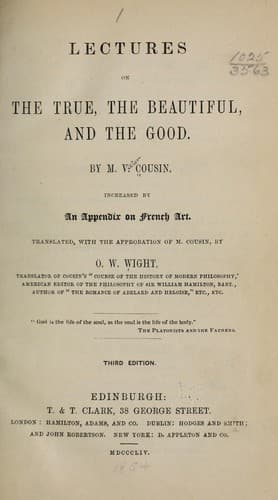
Lectures on the true, the beautiful and the goodCousin, Victor
Philosophy
Lectures on the true, the beautiful and the good
Cousin, Victor
Aesthetics; Ethics; Truth
You desire that the murderer may be arrested and delivered up to
justice, you desire that he may be punished; when he has been arrested,
delivered up to justice, and punished, you are satisfied. What does that
mean? Is it a capricious movement of the imagination and heart? No. Calm
or indignant, at the moment of the crime or a long time after, without
any spirit of personal vengeance, since you are not the least interested
in this affair, you none the less declare that the murderer ought to be
punished. If, instead of receiving a punishment, the culpable man makes
his crime a stepping-stone to fortune, you still declare that, far from
deserving prosperity, he deserves to suffer in reparation of his fault;
you protest against lot, and appeal to a superior justice. This judgment
philosophers have called the judgment of merit and demerit. I suppose,
in the mind of man, the idea of a supreme law that attaches happiness to
virtue, unhappiness to crime. Omit the idea of this law, and the
judgment of merit and demerit is without foundation. Omit this judgment,
and indignation against prosperous crime and the neglect of virtue is an
unintelligible, even an impossible sentiment, and never, at the sight of
crime, would you think of demanding the chastisement of a criminal.
All the parts of the moral phenomenon are connected together; all are
equally certain parts,--destroy one, and you completely overturn the
whole phenomenon. The most common observation bears witness to all these
facts, and the least subtle logic easily discovers their connection. It
is necessary to renounce even sentiment, or it must be avowed that
sentiment covers a judgment, the judgment of the essential distinction
between good and evil, that this distinction involves an obligation,
that this obligation is applied to an intelligent and free agent; in
fine, it must be observed that the distinction between merit and
demerit, that corresponds to the distinction between good and evil,
contains the principle of the natural harmony between virtue and
happiness.
What have we done thus far? We have done as the physicist or chemist
does, who submits a composite body to analysis and reduces it to its
simple elements. The only difference here is that the phenomenon to
which our analysis is applied is in us, instead of being out of us.
Besides, the processes employed are exactly the same; there is in them
neither system nor hypothesis; there are only experience and the most
immediate induction.
In order to render experience more certain, we may vary it. Instead of
examining what takes place in us when we are spectators of bad or good
actions in another, let us interrogate our own consciousness when we are
doing well or ill. In this case, the different elements of the moral
phenomenon are still more striking, and their order appears more
distinctly.
Public-domain text, read in full here on John Shaqi.
Reviews
Reviews
No reviews yet
Be the first to share your thoughts on this work.
Elsewhere in the archive
Join the Discussion
Join the discussion
Sign in to leave a comment or review.
Sign InorCreate an account