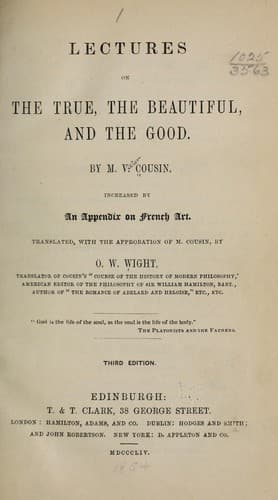
Lectures on the true, the beautiful and the goodCousin, Victor
Philosophy
Lectures on the true, the beautiful and the good
Cousin, Victor
Aesthetics; Ethics; Truth
Suppose that a dying friend has confided to me a more or less important
deposit, charging me to remit it after his death to a person whom he has
designated to me alone, and who himself knows not what has been done in
his favor. He who confided to me the deposit dies, and carries with him
his secret; he for whom the deposit has been made to me has no knowledge
of it; if, then, I wish to appropriate this deposit to myself, no one
will ever be able to suspect me. In this case what should I do? It is
difficult to imagine circumstances more favorable for crime. If I
consult only interest, I ought not to hesitate to return the deposit. If
I hesitate, in the system of interest, I am senseless, and I revolt
against the law of my nature. Doubt alone, in the impunity that is
assured me, would betray in me a principle different from interest.
But naturally I do not doubt, I believe with the most entire certainty,
that the deposit confided to me does not belong to me, that it has been
confided to me to be remitted to another, and that to this other it
belongs. Take away interest, and I should not even think of returning
this deposit,--it is interest alone that tempts me. It tempts me, it
does not bear me away without resistance. Hence the struggle between
interest and duty,--a struggle filled with troubles, opposite
resolutions, by turns taken and abandoned; it energetically attests the
presence of a principle of action different from interest and quite as
powerful.
Duty succumbs, interest triumphs over it. I retain the deposit that has
been confided to me, and apply it to my own wants, and to the wants of
my family; it makes me rich, and in appearance happy; but I internally
suffer with that bitter and secret suffering that is called
remorse.[217] The fact is certain; it has been a thousand times
described; all languages contain the word, and there is no one who, in
some degree, has not experienced the thing, that sharp gnawing at the
heart which is caused by every fault, great or small, as long as it has
not been expiated. This painful recollection follows me in the midst of
pleasures and prosperity. The applauses of the crowd are not able to
silence this inexorable witness. Only a long habit of sin and crime, an
accumulation of oft-repeated faults, can compass this sentiment, at once
avenging and expiatory. When it is stifled, every resource is lost, and
an end is made of the soul's life; as long as it endures, the sacred
fire is not wholly extinguished.
Public-domain text, read in full here on John Shaqi.
Reviews
Reviews
No reviews yet
Be the first to share your thoughts on this work.
Elsewhere in the archive
Join the Discussion
Join the discussion
Sign in to leave a comment or review.
Sign InorCreate an account