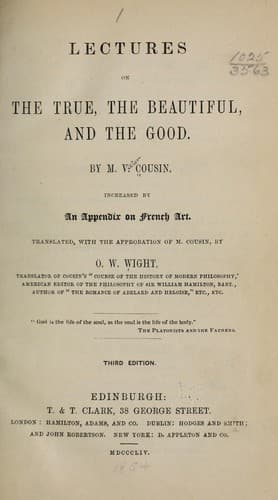
Lectures on the true, the beautiful and the goodCousin, Victor
Philosophy
Lectures on the true, the beautiful and the good
Cousin, Victor
Aesthetics; Ethics; Truth
[231] On Jacobi, see Tennemann's _Manual of the History of Philosophy_,
vol. iii., p. 318, etc.
[232] On this important question of method, see lecture 12.
LECTURE XV.
PRIVATE AND PUBLIC ETHICS.
Application of the preceding principles.--General formula of
interest,--to obey reason.--Rule for judging whether an action
is or is not conformed to reason,--to elevate the motive of this
action into a maxim of universal legislation.--Individual
ethics. It is not towards the individual, but towards the moral
person that one is obligated. Principle of all individual
duties,--to respect and develop the moral person.--Social
ethics,--duties of justice and duties of charity.--Civil
society. Government. Law. The right to punish.
We know that there is moral good and that there is moral evil: we know
that this distinction between good and evil engenders an obligation, a
law, duty; but we do not yet know what our duties are. The general
principle of ethics is laid down; it must be followed at least into its
most important applications.
If duty is only truth become obligatory, and if truth is known only by
reason, to obey the law of duty, is to obey reason.
But to obey reason is a precept very vague and very abstract:--how can
we be sure that our action is conformed or is not conformed to reason?
The character of reason being, as we have said, its universality,
action, in order to be conformed to reason, must possess something
universal; and as it is the motive itself of the action that gives it
its morality, it is also the motive that must, if the action is good,
reflect the character of reason. By what sign, then, do you recognize
that an action is conformed to reason, that it is good? By the sign that
the motive of this action being generalized, appears to you a maxim of
universal legislation, which reason imposes upon all intelligent and
free beings. If you are not able thus to generalize the motive of an
action, and if it is the opposite motive that appears to you a universal
maxim, your action, being opposed to this maxim, is thereby proved to be
contrary to reason and duty,--it is bad. If neither the motive of your
action nor the motive of the opposite action can be erected into a
universal law, the action is neither good nor bad, it is indifferent.
Such is the ingenious measure that Kant has applied to the morality of
actions. It makes known with the last degree of clearness where duty is
and where it is not, as the severe and naked form of syllogism, being
applied to reasoning, brings out in the precisest manner its error or
its truth.
To obey reason,--such is duty in itself, the duty superior to all other
duties, giving to all others their foundation, and being itself founded
only on the essential relation between liberty and reason.
Public-domain text, read in full here on John Shaqi.
Reviews
Reviews
No reviews yet
Be the first to share your thoughts on this work.
Elsewhere in the archive
Join the Discussion
Join the discussion
Sign in to leave a comment or review.
Sign InorCreate an account