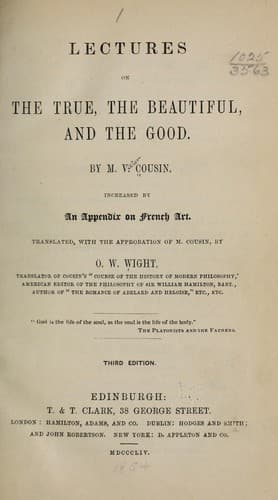
Lectures on the true, the beautiful and the goodCousin, Victor
Philosophy
Lectures on the true, the beautiful and the good
Cousin, Victor
Aesthetics; Ethics; Truth
It is important to repeat continually, that nothing is so easy as to
arrange a system, by suppressing or altering the facts that embarrass
it. But is it, then, the object of philosophy to produce at any cost a
system, instead of seeking to understand the truth and express it as it
is?
It is objected that such a doctrine has not sufficient character. But is
it not sporting with philosophy to demand of it any other character than
that of truth? Do men complain that modern chemistry has not sufficient
character, because it limits itself to studying facts in their
relations, and also in their differences, and because it does not end at
a single substance? The only true philosophy that is proper for a
century returned from all exaggerations, is a picture of human nature
whose first merit is fidelity, which must offer all the traits of the
original in their right proportion and real harmony. The unity of the
doctrine that we profess is in that of the human soul, whence we have
drawn it. Is it not one and the same being that perceives the good, that
knows that he is obligated to fulfil it, that knows that he is free in
fulfilling it, that loves the good, and judges that the fulfilment or
violation of the good justly brings after it reward or punishment,
happiness or misery? We draw, then, a true unity from the intimate
relation between all the facts that, as we have seen, imply and sustain
each other. But by what right is the unity of a doctrine placed in
allowing in it only a single principle? Such a unity is possible only
in those regions of mathematical abstraction, where one is not disturbed
by what is, where one retrenches at will from the object that he is
studying, in order to simplify it continually, where every thing is
reduced to pure notions. In the reality all is determined, and
consequently, all is complex. A science of facts is not a series of
equations. In it must be found again the life that is in things, life
with its harmony doubtless, but also with its richness and
diversity.[232]
FOOTNOTES:
[216] On indignation, see lecture 11.
[217] On remorse, see lecture 11.
[218] See the _Gorgias_, with the _Argument_, vol. iii. of our
translation.
[219] Lectures 1 and 6.
[220] Lectures 2, 3, and 6.
[221] 1st part, lecture 2.
[222] Lecture 2.
[223] 1st part, lecture 3. See also vol. v. of the 1st Series, lecture
8.
[224] 1st Series, vol. v., lecture 7.
[225] See, for the entire development of the theory of liberty, 1st
Series, vol. iii., lecture 1, _Locke_, p. 71; lecture 3, _Condillac_, p.
116, 149, etc.; vol. iv., lecture 23, _Reid_, p. 541-574; 2d Series,
vol. iii., _Examination of the System of Locke_, lecture 25.
[226] Lecture 12.
[227] See 1st Series, vol. iv., Lecture on Smith and on the true
principle of political economy, p. 278-302.
[228] Le crime fait la honte et non pas l'echafaud.
[229] See lecture 16, _God, the Principle of the Idea of the Good_.
[230] See lecture 16.
Public-domain text, read in full here on John Shaqi.
Reviews
Reviews
No reviews yet
Be the first to share your thoughts on this work.
Elsewhere in the archive
Join the Discussion
Join the discussion
Sign in to leave a comment or review.
Sign InorCreate an account