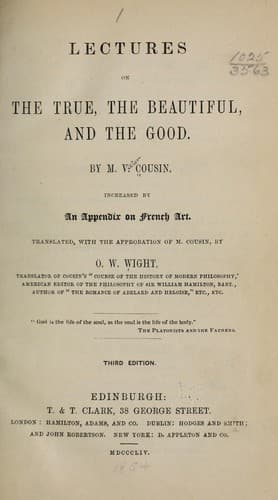
Lectures on the true, the beautiful and the goodCousin, Victor
Philosophy
Lectures on the true, the beautiful and the good
Cousin, Victor
Aesthetics; Ethics; Truth
Man must, before every thing else, occupy himself with his
intelligence. It is in fact our intelligence that alone can give us a
clear sight of the true and the good, that guides liberty by showing it
the legitimate object of its efforts. No one can give himself another
mind than the one that he has received, but he may train and strengthen
it as well as the body, by putting it to a task of some kind, by rousing
it when it is drowsy, by restraining it when it is carried away, by
continually proposing to it new objects,--for it is only by continually
enriching it that it does not grow poor. Sloth benumbs and enervates the
mind; regular work excites and strengthens it, and work is always in our
power.
There is an education of liberty as well as our other faculties. It is
sometimes in subduing the body, sometimes in governing our intelligence,
especially in resisting our passions, that we learn to be free. We
encounter opposition at each step,--the only question is not to shun it.
In this constant struggle liberty is formed and augmented, until it
becomes a habit.
Finally, there is a culture of sensibility itself. Fortunate are those
who have received from nature the sacred fire of enthusiasm! They ought
religiously to preserve it. But there is no soul that does not conceal
some fortunate vein of it. It is necessary to watch it and pursue, to
avoid what restrains it, to seek what favors it, and, by an assiduous
culture, draw from it, little by little, some treasures. If we cannot
give ourselves sensibility, we can at least develop what we have. We can
do this by giving ourselves up to it, by seizing all the occasions of
giving ourselves up to it, by calling to its aid intelligence itself;
for, the more we know of the beautiful and the good, the more we love
it. Sentiment thereby only borrows from intelligence what it returns
with usury. Intelligence in its turn finds, in the heart, a rampart
against sophism. Noble, sentiments, nourished and developed, preserve
from those sad systems that please certain spirits so much only because
their hearts are so small.
Man would still have duties, should he cease to be in relation with
other men.[234] As long as he preserves any intelligence and any
liberty, the idea of the good dwells in him, and with it duty. Were we
cast upon a desert island, duty would follow us thither. It would be
beyond belief strange that it should be in the power of certain
external circumstances to affranchise an intelligent and free being from
all obligation towards his liberty and his intelligence. In the deepest
solitude he is always and consciously under the empire of a law attached
to the person itself, which, by obligating him to keep continual watch
over himself, makes at once his torment and his grandeur.
If the moral person is sacred to me, it is not because it is in me, it
is because it is the moral person; it is in itself respectable; it will
be so, then, wherever we meet it.
Public-domain text, read in full here on John Shaqi.
Reviews
Reviews
No reviews yet
Be the first to share your thoughts on this work.
Elsewhere in the archive
Join the Discussion
Join the discussion
Sign in to leave a comment or review.
Sign InorCreate an account