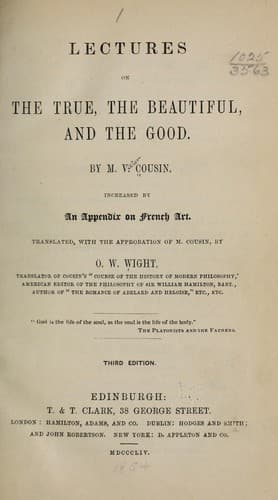
Lectures on the true, the beautiful and the goodCousin, Victor
Philosophy
Lectures on the true, the beautiful and the good
Cousin, Victor
Aesthetics; Ethics; Truth
It is in you as in me, and for the same reason. In relation to me it
imposes on me a duty; in you it becomes the foundation of a right, and
thereby imposes on me a new duty in relation to you.
I owe to you truth as I owe it to myself; for truth is the law of your
reason as of mine. Without doubt there ought to be measure in the
communication of truth,--all are not capable of it at the same moment
and in the same degree; it is necessary to portion it out to them in
order that they may be able to receive it; but, in fine, the truth is
the proper good of the intelligence; and it is for me a strict duty to
respect the development of your mind, not to arrest, and even to favor
its progress towards truth.
I ought also to respect your liberty. I have not even always the right
to hinder you from committing a fault. Liberty is so sacred that, even
when it goes astray, it still deserves, up to a certain point, to be
managed. We are often wrong in wishing to prevent too much the evil that
God himself permits. Souls may be corrupted by an attempt to purify
them.
I ought to respect you in your affections, which make part of yourself;
and of all the affections there are none more holy than those of the
family. There is in us a need of expanding ourselves beyond ourselves,
yet without dispelling ourselves, of establishing ourselves in some
souls by a regular and consecrated affection,--to this need the family
responds. The love of men is something of the general good. The family
is still almost the individual, and not merely the individual,--it only
requires us to love as much as ourselves what is almost ourselves. It
attaches one to the other, by the sweetest and strongest of all
ties--father, mother, child; it gives to this sure succor in the love of
its parents--to these hope, joy, new life, in their child. To violate
the conjugal or paternal right, is to violate the person in what is
perhaps its most sacred possession.
I ought to respect your body, inasmuch as it belongs to you, inasmuch as
it is the necessary instrument of your person. I have neither the right
to kill you, nor to wound you, unless I am attacked and threatened; then
my violated liberty is armed with a new right, the right of defence and
even constraint.
I owe respect to your goods, for they are the product of your labor; I
owe respect to your labor, which is your liberty itself in exercise;
and, if your goods come from an inheritance, I still owe respect to the
free will that has transmitted them to you.[235]
Respect for the rights of others is called justice; every violation of a
right is an injustice.
Every injustice is an encroachment upon our person,--to retrench the
least of our rights, is to diminish our moral person, is, at least, so
far as that retrenchment goes, to abase us to the condition of a thing.
Public-domain text, read in full here on John Shaqi.
Reviews
Reviews
No reviews yet
Be the first to share your thoughts on this work.
Elsewhere in the archive
Join the Discussion
Join the discussion
Sign in to leave a comment or review.
Sign InorCreate an account