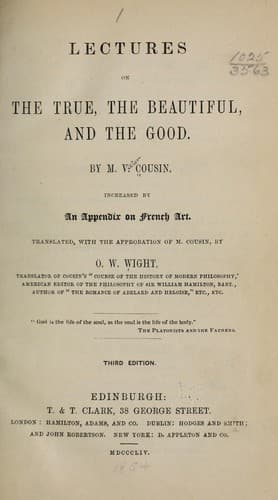
Lectures on the true, the beautiful and the goodCousin, Victor
Philosophy
Lectures on the true, the beautiful and the good
Cousin, Victor
Aesthetics; Ethics; Truth
The greatest of all injustices, because it comprises all others, is
slavery. Slavery is the subjecting of all the faculties of one man to
the profit of another man. The slave develops his intelligence a little
only in the interest of another,--it is not for the purpose of
enlightening him, but to render him more useful, that some exercise of
mind is allowed him. The slave has not the liberty of his movements; he
is attached to the soil, is sold with it, or he is chained to the person
of a master. The slave should have no affection, he has no family, no
wife, no children,--he has a female and little ones. His activity does
not belong to him, for the product of his labor is another's. But, that
nothing may be wanting to slavery, it is necessary to go farther,--in
the slave must be destroyed the inborn sentiment of liberty, in him must
be extinguished all idea of right; for, as long as this idea subsists,
slavery is uncertain, and to an odious power may respond the terrible
right of insurrection, that last resort of the oppressed against the
abuse of force.[236]
Justice, respect for the person in every thing that constitutes the
person, is the first duty of man towards his fellow-man. Is this duty
the only one?
When we have respected the person of others, when we have neither
restrained their liberty, nor smothered their intelligence, nor
maltreated their body, nor outraged their family, nor injured their
goods, are we able to say that we have fulfilled the whole law in regard
to them? One who is unfortunate is suffering before us. Is our
conscience satisfied, if we are able to bear witness to ourselves that
we have not contributed to his sufferings? No; something tells that it
is still good to give him bread, succor, consolation.
There is here an important distinction to be made. If you have remained
hard and insensible at the sight of another's misery, conscience cries
out against you; and yet this man who is suffering, who, perhaps, is
ready to die, has not the least right over the least part of your
fortune, were it immense; and, if he used violence for the purpose of
wresting from you a single penny, he would commit a crime. We here meet
a new order of duties that do not correspond to rights. Man may resort
to force in order to make his rights respected; he cannot impose on
another any sacrifice whatever. Justice respects or restores; charity
gives, and gives freely.
Charity takes from us something in order to give it to our fellow-men.
If it goes so far as to inspire us to renounce our dearest interests, it
is called devotedness.
Public-domain text, read in full here on John Shaqi.
Reviews
Reviews
No reviews yet
Be the first to share your thoughts on this work.
Elsewhere in the archive
Join the Discussion
Join the discussion
Sign in to leave a comment or review.
Sign InorCreate an account