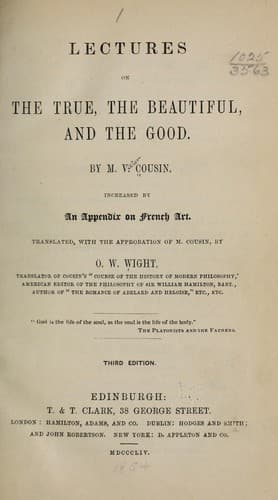
Lectures on the true, the beautiful and the goodCousin, Victor
Philosophy
Lectures on the true, the beautiful and the good
Cousin, Victor
Aesthetics; Ethics; Truth
Let us avoid at first the question of the origin of society.[237] The
philosophy of the last century delighted in such questions too much. How
can we demand light from the regions of darkness, and the explanation of
reality from an hypothesis? Why go back to a pretended primitive state
in order to account for a present state which may be studied in itself
in its unquestionable characters? Why seek what may have been in the
germ that which may be perceived, that which it is the question to
understand, completed and perfect? Moreover, there is great peril in
starting with the question of the origin of society. Has such or such an
origin been found? Actual society is arranged according to the type of
the primitive society that has been dreamed of, and political society is
delivered up to the mercy of historical romances. This one imagines that
the primitive state is violence, and he sets out from that in order to
authorize the right of the strongest, and to consecrate despotism. That
one thinks that he has found in the family the first form of society,
and he compares government to the father of a family, and subjects to
children; society in his eyes is a minor that must be held in tutelage
in the hands of the paternal power, which in the origin is absolute, and
consequently, must remain so. Or has one thrown himself to the extreme
of the opposite opinion, and into the hypothesis of an agreement, of a
contract that expresses the will of all or of the greatest number? He
delivers up to the mobile will of the crowd the eternal laws of justice
and the inalienable rights of the person. Finally, are powerful
religious institutions found in the cradle of society? It is hence
concluded, that power belongs of right to priesthoods, which have the
secret of the designs of God, and represent his sovereign authority.
Thus a vicious method in philosophy leads to a deplorable political
system,--the commencement is made in hypothesis, and the termination is
in anarchy or tyranny.
True politics do not depend on more or less well directed historical
researches into the profound night of a past forever vanished, and of
which no vestige subsists: they rest on the knowledge of human nature.
Wherever society is, wherever it was, it has for its foundations:--1st,
The need that we have of our fellow-creatures, and the social instincts
that man bears in himself; 2d, The permanent and indestructible idea and
sentiment of justice and right.
Public-domain text, read in full here on John Shaqi.
Reviews
Reviews
No reviews yet
Be the first to share your thoughts on this work.
Elsewhere in the archive
Join the Discussion
Join the discussion
Sign in to leave a comment or review.
Sign InorCreate an account