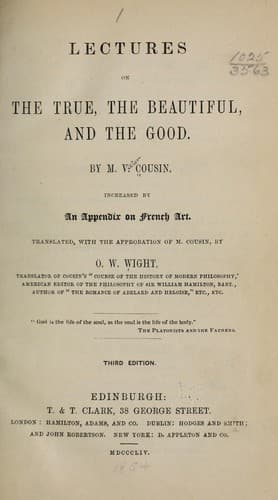
Lectures on the true, the beautiful and the goodCousin, Victor
Philosophy
Lectures on the true, the beautiful and the good
Cousin, Victor
Aesthetics; Ethics; Truth
Man, feeble and powerless when he is alone, profoundly feels the need
that he has of the succor of his fellow-creatures in order to develop
his faculties, to embellish his life, and even to preserve it.[238]
Without reflection, without convention, he claims the hand, the
experience, the love of those whom he sees made like himself. The
instinct of society is in the first cry of the child that calls for the
mother's help without knowing that it has a mother, and in the eagerness
of the mother to respond to the cries of the child. It is in the
feelings for others that nature has put in us--pity, sympathy,
benevolence. It is in the attraction of the sexes, in their union, in
the love of parents for their children, and in the ties of every kind
that these first ties engender. If Providence has attached so much
sadness to solitude, so much charm to society, it is because society is
indispensable for the preservation of man and for his happiness, for his
intellect and moral development.
But if need and instinct begin society, it is justice that completes it.
In the presence of another man, without any external law, without any
compact,[239] it is sufficient that I know that he is a man, that is to
say, that he is intelligent and free, in order to know that he has
rights, and to know that I ought to respect his rights as he ought to
respect mine. As he is no freer than I am, nor I than he, we recognize
towards each other equal rights and equal duties. If he abuses his force
to violate the equality of our rights, I know that I have the right to
defend myself and make myself respected; and if a third party is found
between us, without any personal interest in the quarrel, he knows that
it is his right and his duty to use force in order to protect the
feeble, and even to make the oppressor expiate his injustice by a
chastisement. Therein is already seen entire society with its essential
principles,--justice, liberty, equality, government, and punishment.
Justice is the guaranty of liberty. True liberty does not consist in
doing what we will, but in doing what we have a right to do. Liberty of
passion and caprice would have for its consequence the enslavement of
the weakest to the strongest, and the enslavement of the strongest
themselves to their unbridled desires. Man is truly free in the interior
of his consciousness only in resisting passion and obeying justice;
therein also is the type of true social liberty. Nothing is falser than
the opinion that society diminishes our mutual liberty; far from that,
it secures it, develops it: what it suppresses is not liberty; it is its
opposite, passion. Society no more injures liberty than justice, for
society is nothing else than the very idea of justice realized.
Public-domain text, read in full here on John Shaqi.
Reviews
Reviews
No reviews yet
Be the first to share your thoughts on this work.
Elsewhere in the archive
Join the Discussion
Join the discussion
Sign in to leave a comment or review.
Sign InorCreate an account