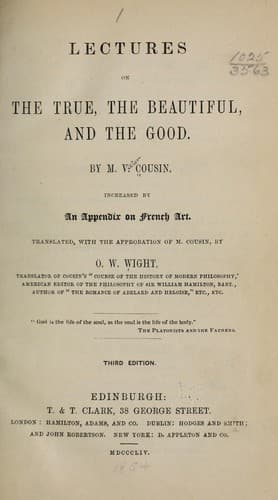
Lectures on the true, the beautiful and the goodCousin, Victor
Philosophy
Lectures on the true, the beautiful and the good
Cousin, Victor
Aesthetics; Ethics; Truth
It is a sad and false political system that places society and
government, authority and liberty, in opposition to each other, by
making them come from two different sources, by presenting them as two
contrary principles. I often hear the principle of authority spoken of
as a principle apart, independent, deriving from itself its force and
legitimacy, and consequently made to rule. No error is deeper and more
dangerous. Thereby it is thought to confirm the principle of authority;
far from that, from it is taken away its solidest foundation.
Authority--that is to say, legitimate and moral authority--is nothing
else than justice, and justice is nothing else than the respect of
liberty; so that there is not therein two different and contrary
opinions, but one and the same principle, of equal certainty and equal
grandeur, under all its forms and in all its applications.
Authority, it is said, comes from God: doubtless; but whence comes
liberty, whence comes humanity? To God must be referred every thing that
is excellent on the earth; and nothing is more excellent than liberty.
Reason, which in man commands liberty, commands it according to its
nature; and the first law that reason imposes on liberty is that of
self-respect.
Authority is so much the stronger as its true title is better
understood; and obedience is the easiest when, instead of degrading, it
honors; when, instead of resembling servitude, it is at once the
condition and guaranty of liberty.
The mission, the end of government, is to make justice, the protector of
the common liberty, reign. Whence it follows, that as long as the
liberty of one citizen does not injure the liberty of another, it
escapes all repression. So government cannot be severe against
falsehood, intemperance, imprudence, levity, avarice, egoism, except
when these vices become prejudicial to others. Moreover, it is not
necessary to confine government within too narrow limits. Government,
which represents society, is also a moral person; it has a heart like
the individual; it has generosity, goodness, charity. There are
legitimate, and even universally admired facts, that are not explained,
if the function of government is reduced to the protection of rights
alone.[242] Government owes to the citizens, in a certain measure, to
guard their well-being, to develop their intelligence, to fortify their
morality, for the interest of society, and even for the interest of
humanity. Hence sometimes for government the formidable right of using
force in order to do good to men. But we are here touching upon that
delicate point where charity inclines to despotism. Too much
intelligence and wisdom, therefore, cannot be demanded in the employment
of a power perhaps necessary, but dangerous.
Public-domain text, read in full here on John Shaqi.
Reviews
Reviews
No reviews yet
Be the first to share your thoughts on this work.
Elsewhere in the archive
Join the Discussion
Join the discussion
Sign in to leave a comment or review.
Sign InorCreate an account