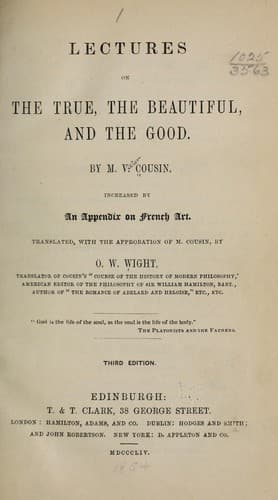
Lectures on the true, the beautiful and the goodCousin, Victor
Philosophy
Lectures on the true, the beautiful and the good
Cousin, Victor
Aesthetics; Ethics; Truth
In securing liberty, justice secures equality also. If men are unequal
in physical force and intelligence, they are equal in so far as they are
free beings, and consequently equally worthy of respect. All men, when
they bear the sacred character of the moral person, are to be respected,
by the same title, and in the same degree.[240]
The limit of liberty is in liberty itself; the limit of right is in
duty. Liberty is to be respected, but provided it injure not the liberty
of an other. I ought to let you do what you please, but on the condition
that nothing which you do will injure my liberty. For then, in virtue of
my right of liberty, I should regard myself as obligated to repress the
aberrations of your will, in order to protect my own and that of others.
Society guaranties the liberty of each one, and if one citizen attacks
that of another, he is arrested in the name of liberty. For example,
religious liberty is sacred; you may, in the secret of consciousness,
invent for yourself the most extravagant superstition; but if you wish
publicly to inculcate an immoral worship, you threaten the liberty and
reason of your citizens: such preaching is interdicted.
From the necessity of repressing springs the necessity of a constituted
repressive force.
Rigorously, this force is in us; for if I am unjustly attacked, I have
the right to defend myself. But, in the first place, I may not be the
strongest; in the second place, no one is an impartial judge in his own
cause, and what I regard or give out as an act of legitimate defence may
be an act of violence and oppression.
So the protection of the rights of each one demands an impartial and
disinterested force, that may be superior to all particular forces.
This disinterested party, armed with the power necessary to secure and
defend the liberty of all, is called government.
The right of government expresses the rights of all and each. It is the
right of personal defence transferred to a public force, to the profit
of common liberty.
Government is not, then, a power distinct from and independent of
society; it draws from society its whole force. It is not what it has
seemed to two opposite schools of publicists,--to those who sacrifice
society to government,--to those who consider government as the enemy of
society. If government did not represent society, it would be only a
material, illegitimate, and soon powerless force; and without
government, society would be a war of all against all. Society makes
the moral power of government, as government makes the security of
society. Pascal is wrong[241] when he says, that not being able to make
what is just powerful, men have made what is powerful just. Government,
in principle at least, is precisely what Pascal desired,--justice armed
with force.
Public-domain text, read in full here on John Shaqi.
Reviews
Reviews
No reviews yet
Be the first to share your thoughts on this work.
Elsewhere in the archive
Join the Discussion
Join the discussion
Sign in to leave a comment or review.
Sign InorCreate an account