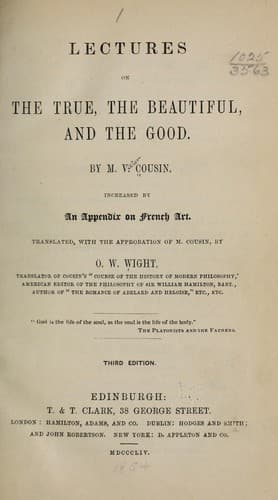
Lectures on the true, the beautiful and the goodCousin, Victor
Philosophy
Lectures on the true, the beautiful and the good
Cousin, Victor
Aesthetics; Ethics; Truth
[243] See on the theory of penalty, the _Gorgias_, vol. iii. of the
translation of Plato, and our argument, p. 367: "The first law of order
is to be faithful to virtue, and to that part of virtue which is related
to society, to wit, justice; but if one is wanting in that, the second
law of order is to expiate one's fault, and it is expiated by
punishment. Publicists are still seeking the foundation of penalty.
Some, who think themselves great politicians, find it in the utility of
the punishment for those who witness it, and are turned aside from crime
by fear of its menace, by its preventive virtue. And that it is true, is
one of the effects of penalty, but it is not its foundation; for
punishment falling upon the innocent, would produce as much, and still
more terror, and would be quite as preventive. Others, in their
pretensions to humanity, do not wish to see the legitimacy of punishment
except in its utility for him who undergoes it, in its corrective
virtue,--and that, too, is one of the possible effects of punishment,
but not its foundation; for that punishment may be corrective, it must
be accepted as just. It is, then, always necessary to recur to justice.
Justice is the true foundation of punishment,--personal and social
utility are only consequences. It is an incontestable fact, that after
every unjust act, man thinks, and cannot but think that he has incurred
demerit, that is to say, has merited a punishment. In intelligence, to
the idea of injustice corresponds that of penalty; and when injustice
has taken place in the social sphere, merited punishment ought to be
inflicted by society. Society can inflict it only because it ought.
Right here has no other source than duty, the strictest, most evident,
and most sacred duty, without which this pretended right would be only
that of force, that is to say, an atrocious injustice, should it even
result in the moral profit of him who undergoes it, and in a salutary
spectacle for the people,--what it would not then be; for then the
punishment would find no sympathy, no echo, either in the public
conscience or in that of the condemned. The punishment is not just,
because it is preventively or correctively useful; but it is in both
ways useful, because it is just." This theory of penalty, in
demonstrating the falsity, the incomplete and exclusive character of two
theories that divide publicists, completes and explains them, and gives
them both a legitimate centre and base. It is doubtless only indicated
in Plato, but is met in several passages, briefly but positively
expressed, and on it rests the sublime theory of expiation.
Public-domain text, read in full here on John Shaqi.
Reviews
Reviews
No reviews yet
Be the first to share your thoughts on this work.
Elsewhere in the archive
Join the Discussion
Join the discussion
Sign in to leave a comment or review.
Sign InorCreate an account