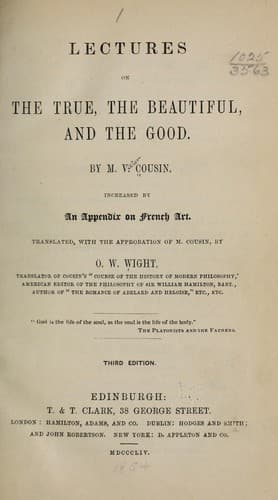
Lectures on the true, the beautiful and the goodCousin, Victor
Philosophy
Lectures on the true, the beautiful and the good
Cousin, Victor
Aesthetics; Ethics; Truth
[244] As it is perceived, we have confined ourselves to the most general
principles. The following year, in 1819, in our lectures on Hobbes, 1st
Series, vol. iii., we gave a more extended theory of rights, and the
civil and political guaranties which they demand; we even touched the
question of the different forms of government, and established the truth
and beauty of the constitutional monarchy. In 1828, 2d Series, vol. i.,
lecture 13, we explained and defended the Charter in its fundamental
parts. Under the government of July, the part of defender of both
liberty and royalty was easy. We continued it in 1848; and when, at the
unexpected inundation of democracy, soon followed by a passionate
reaction in favor of an absolute authority, many minds, and the best,
asked themselves whether the young American republic was not called to
serve as a model for old Europe, we did not hesitate to maintain the
principle of the monarchy in the interest of liberty; we believe that we
demonstrated that the development of the principles of 1789, and in
particular the progress of the lower classes, so necessary, can be
obtained only by the aid of the constitutional monarchy,--6th Series,
POLITICAL DISCOURSES, _with an introduction on the principles of the
French Revolution and representative government_.
LECTURE XVI.
GOD THE PRINCIPLE OF THE IDEA OF THE GOOD.
Principle on which true theodicea rests. God the last foundation
of moral truth, of the good, and of the moral person.--Liberty
of God.--The divine justice and charity.--God the sanction of
the moral law. Immortality of the soul; argument from merit and
demerit; argument from the simplicity of the soul; argument from
final causes.--Religious sentiment.--Adoration.--Worship.--Moral
beauty of Christianity.
The moral order has been confirmed,--we are in possession of moral
truth, of the idea of the good, and the obligation that is attached to
it. Now, the same principle that has not permitted us to stop at
absolute truth,[245] and has forced us to seek its supreme reason in a
real and substantial being, forces us here again to refer the idea of
the good to the being who is its first and last foundation.
Moral truth, like every other universal and necessary truth, cannot
remain in a state of abstraction. In us it is only conceived. There must
somewhere be a being who not only conceives it, but constituted it.
As all beautiful things and all true things are related--these to a
unity that is absolute truth, and those to another unity that is
absolute beauty, so all moral principles participate in the same
principle, which is the good. We thus elevate ourselves to the
conception of the good in itself, of absolute good, superior to all
particular duties, and determined in these duties. Now, can the absolute
good be any thing else than an attribute of him who, properly speaking,
is alone absolute being?
Public-domain text, read in full here on John Shaqi.
Reviews
Reviews
No reviews yet
Be the first to share your thoughts on this work.
Elsewhere in the archive
Join the Discussion
Join the discussion
Sign in to leave a comment or review.
Sign InorCreate an account