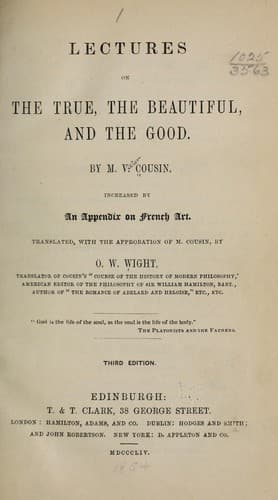
Lectures on the true, the beautiful and the goodCousin, Victor
Philosophy
Lectures on the true, the beautiful and the good
Cousin, Victor
Aesthetics; Ethics; Truth
In the same manner as we transfer to God the liberty that is the
foundation of our being, we also transfer to him justice and charity. In
man, justice and charity are virtues; in God, they are attributes. What
is in us the laborious conquest of liberty, is in him his very nature.
If respect of rights is in us the very essence of justice and the sign
of the dignity of our being, it is impossible that the perfect being
should not know and respect the rights of the lowest beings, since it is
he, moreover, who has imparted to them those rights. In God resides a
sovereign justice, which renders to each one his due, not according to
deceptive appearances, but according to the truth of things. Finally, if
man, that limited being, has the power of going out of himself, of
forgetting his person, of loving another than himself, of devoting
himself to another's happiness, or, what is better, to the perfecting of
another, should not the perfect being have, in an infinite degree, this
disinterested tenderness, this charity, the supreme virtue of the human
person? Yes, there is in God an infinite tenderness for his creatures:
he at first manifested it in giving us the being that he might have
withheld, and at all times it appears in the innumerable signs of his
divine providence. Plato knew this love of God well, and expressed it in
those great words, "Let us say that the cause which led the supreme
ordainer to produce and compose this universe is, that he was good; and
he who is good has no species of envy. Exempt from envy, he willed that
all things should be, as much as possible, like himself."[251]
Christianity went farther: according to the divine doctrine, God so
loved men that he gave them his only Son. God is inexhaustible in his
charity, as he is inexhaustible in his essence. It is impossible to give
more to the creature; he gives him every thing that he can receive
without ceasing to be a creature; he gives him every thing, even
himself, so far as the creature is in him and he in the creature. At the
same time nothing can be lost; for being absolute being, he eternally
expands and gives himself without being diminished. Infinite in power,
infinite in charity, he bestows his love in exhaustless abundance upon
the world, to teach us that the more we give the more we possess. It is
egoism, whose root is at the bottom of every heart, even by the side of
the sincerest charity, that inculcates in us the error that we lose by
self-devotion: it is egoism that makes us call devotion a sacrifice.
If God is wholly just and wholly good, he can will nothing but what is
good and just; and, as he is all-powerful, every thing that he wills he
can do, and consequently does do. The world is the work of God; it is
therefore perfectly made, perfectly adapted to its end.
And nevertheless, there is in the world a disorder that seems to accuse
the justice and goodness of God.
Public-domain text, read in full here on John Shaqi.
Reviews
Reviews
No reviews yet
Be the first to share your thoughts on this work.
Elsewhere in the archive
Join the Discussion
Join the discussion
Sign in to leave a comment or review.
Sign InorCreate an account