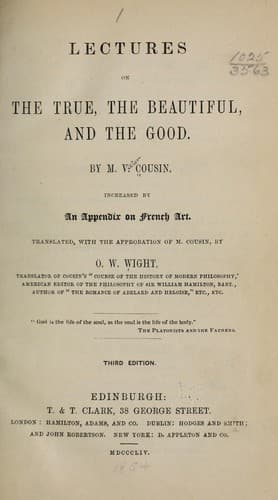
Lectures on the true, the beautiful and the goodCousin, Victor
Philosophy
Lectures on the true, the beautiful and the good
Cousin, Victor
Aesthetics; Ethics; Truth
The first notion that we have of God, to wit, the notion of an infinite
being, is itself given to us independently of all experience. It is the
consciousness of ourselves, as being at once, and as being limited, that
elevates us directly to the conception of a being who is the principle
of our being, and is himself without bounds. This solid and single
argument, which is at bottom that of Descartes,[247] opens to us a way
that must be followed, in which Descartes too quickly stopped. If the
being that we possess forces us to recur to a cause which possesses
being in an infinite degree, all that we have of being, that is to say,
of substantial attributes, equally requires an infinite cause. Then, God
will no longer be merely the infinite, abstract, or at least
indeterminate being in which reason and the heart know not where to
betake themselves,[248] he will be a real and determined being, a moral
person like ours and psychology conducts us without hypothesis to a
theodicea at once sublime and related to us.[249]
Before all, if man is free, can it be that God is not free? No one
contends that he who is cause of all causes, who has no cause but
himself, can be dependent on any thing whatever. But in freeing God from
all external constraint, Spinoza subjects him to an internal and
mathematical necessity, wherein he finds the perfection of being. Yes,
of being which is not a person; but the essential character of personal
being is precisely liberty. If, then, God were not free, God would be
beneath man. Would it not be strange that the creature should have the
marvellous power of disposing of himself, and of freely willing, and
that the being who has made him should be subjected to a necessary
development, whose cause is only in himself, without doubt, but, in
fine, is a sort of abstract power, mechanical or metaphysical, but very
inferior to the personal and voluntary cause that we are, and of which
we have the clearest consciousness? God is therefore free, since we are
free. But he is not free as we are free; for God is at once all that we
are, and nothing that we are. He possesses the same attributes that we
possess, but elevated to infinity. He possesses an infinite liberty,
joined to an infinite intelligence; and, as his intelligence is
infallible, excepted from the uncertainties of deliberation, and
perceiving at a glance where the good is, so his liberty spontaneously,
and without effort, fulfils it.[250]
Public-domain text, read in full here on John Shaqi.
Reviews
Reviews
No reviews yet
Be the first to share your thoughts on this work.
Elsewhere in the archive
Join the Discussion
Join the discussion
Sign in to leave a comment or review.
Sign InorCreate an account