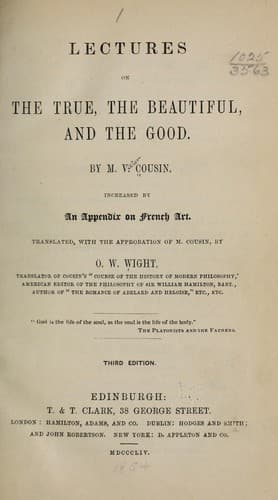
Lectures on the true, the beautiful and the goodCousin, Victor
Philosophy
Lectures on the true, the beautiful and the good
Cousin, Victor
Aesthetics; Ethics; Truth
I regret that upon this point time does not allow of any development. It
would have afforded me delight, after having distinguished virtue from
happiness, to show them to you almost always united by the admirable law
of merit and demerit. I should have been pleased to show you this
beneficent law already governing human destiny, and called to preside
over it more exactly from day to day by the ever-increasing progress of
lights in governments and peoples, by the perfecting of civil and
judicial institutions. It would have been my wish to make pass into your
minds and hearts the consoling conviction that, after all, justice is
already in this world, and that the surest road to happiness is still
that of virtue.
This was the opinion of Socrates and Plato; and it is also that of
Franklin, and I gather it from my personal experience and an attentive
examination of human life. But I admit that there are exceptions; and
were there but one exception, it would be necessary to explain it.
Suppose a man, young, beautiful, rich, amiable, and loved, who, placed
between the scaffold and the betrayal of a sacred cause, voluntarily
mounts the scaffold at twenty years of age. What do you make of this
noble victim? The law of merit and demerit seems here suspended. Do you
dare blame virtue, or how in this world do you accord to it the
recompense that it has not sought, but is its due?
By careful search you will find more than one case analogous to that.
The laws of this world are general; they turn aside to suit no one: they
pursue their course without regard to the merit or demerit of any. If a
man is born with a bad temperament, it is in virtue of certain obscure
but undeviating physical laws, to which he is subject, like the animal
and the plant, and he suffers during his whole life, although personally
innocent. He is brought up in the midst of flames, epidemics, calamities
that strike at hazard the good as well as the bad.
Human justice condemns many that are innocent, it is true, but it
absolves, in fault of proof, more than one who is culpable. Besides, it
knows only certain derelictions. What faults, what basenesses occur in
the dark, which do not receive merited chastisement! In like manner,
what obscure devotions of which God is the sole witness and judge!
Without doubt nothing escapes the eye of conscience, and the culpable
soul cannot escape remorse. But remorse is not always in exact relation
with the fault committed; its vivacity may depend on a nature more or
less delicate, on education and habit. In a word, if it is in general
very true that the law of merit and demerit is fulfilled in this world,
it is not fulfilled with mathematical rigor.
Public-domain text, read in full here on John Shaqi.
Reviews
Reviews
No reviews yet
Be the first to share your thoughts on this work.
Elsewhere in the archive
Join the Discussion
Join the discussion
Sign in to leave a comment or review.
Sign InorCreate an account