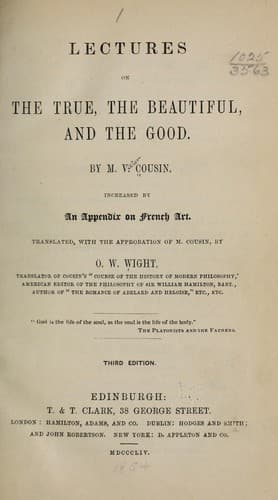
Lectures on the true, the beautiful and the goodCousin, Victor
Philosophy
Lectures on the true, the beautiful and the good
Cousin, Victor
Aesthetics; Ethics; Truth
What must we conclude from this? That the world is ill-made? No. That
cannot be, and is not. That cannot be, for incontestably the world has a
just and good author; that is not, for, in fact, we see order reigning
in the world; and it would be absurd to misconceive the manifest order
that almost everywhere shines forth on account of a few phenomena that
we cannot refer to order. The universe endures, therefore it is well
made. The pessimism of Voltaire is still more opposed to the aggregate
of facts than an absolute optimism. Between these two systematic
extremes which facts deny, the human race places the hope of another
life. It has found it very irrational to reject a necessary law on
account of some infractions; it has, therefore, maintained the law; and
from infractions it has only concluded that they ought to be referred to
the law, that there will be a reparation. Either this conclusion must be
admitted, or the two great principles previously admitted, that God is
just, and that the law of merit and demerit is an absolute law, must be
rejected.
Now, to reject these two principles is to totally overthrow all human
belief.
To maintain them, is implicitly to admit that actual life must be,
elsewhere terminated or continued.
But is this continuation of the person possible? After the dissolution
of the body, can any thing of us remain?
In truth, the moral person, which acts well or ill, which awaits the
reward or punishment of its good or bad actions, is united to a
body,--it lives with the body, makes use of it, and, in a certain
measure, depends on it, but is not it.[253] The body is composed of
parts, may decrease or increase; is divisible, essentially divisible,
and even infinitely divisible. But that something that has consciousness
of itself, that says, _I_, _me_, that feels itself to be free and
responsible, does it not also feel that there is in it no division,
even no possible division, that it is a being one and simple? Is the
_me_ more or less _me_? Is there a half of _me_, a quarter of _me_? I
cannot divide my person. It remains identical to itself under the
diversity of the phenomena that manifest it. This identity, this
indivisibility of the person, is its spirituality. Spirituality is,
therefore, the very essence of the person. Belief in the spirituality of
the soul is involved in the belief of this identity of the _me_, which
no rational being has ever called in question. Accordingly, there is not
the least hypothesis for affirming that the soul does not essentially
differ from the body. Add that when we say the soul, we mean to say, and
do say the person, which is not separated from the consciousness of the
attributes that constitute it, thought and will. The being without
consciousness is not a person. It is the person that is identical, one,
simple. Its attributes, in developing it, do not divide it. Indivisible,
it is indissoluble, and may be immortal. If, then, divine justice, in
Public-domain text, read in full here on John Shaqi.
Reviews
Reviews
No reviews yet
Be the first to share your thoughts on this work.
Elsewhere in the archive
Join the Discussion
Join the discussion
Sign in to leave a comment or review.
Sign InorCreate an account