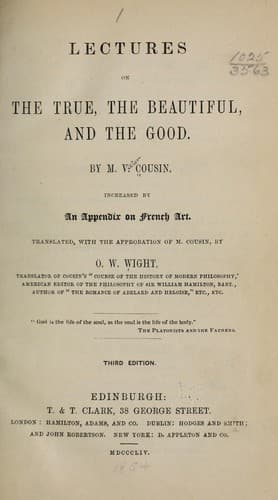
Lectures on the true, the beautiful and the goodCousin, Victor
Philosophy
Lectures on the true, the beautiful and the good
Cousin, Victor
Aesthetics; Ethics; Truth
order to be exercised in regard to us, demands an immortal soul, it does
not demand an impossible thing. The spirituality of the soul is the
necessary foundation of immortality. The law of merit and demerit is the
direct demonstration of this. The first proof is called the metaphysical
proof, the second, the moral proof, which is the most celebrated, most
popular, at once the most convincing and the most persuasive.
What powerful motives are added to these two proofs to fortify them in
the heart! The following, for example, is a presumption of great value
for any one that believes in the virtue of sentiment and instinct.
Every thing has its end. This principle is as absolute as that which
refers every event to a cause.[254] Man has, therefore, an end. This end
is revealed in all his thoughts, in all his ways, in all his sentiments,
in all his life. Whatever he does, whatever he feels, whatever he
thinks, he thinks upon the infinite, loves the infinite, tends to the
infinite.[255] This need of the infinite is the mainspring of scientific
curiosity, the principle of all discoveries. Love also stops and rests
only there. On the route it may experience lively joys; but a secret
bitterness that is mingled with them soon makes it feel their
insufficiency and emptiness. Often, while ignorant of its true object,
it asks whence comes that fatal disenchantment by which all its
successes, all its pleasures are successively extinguished. If it knew
how to read itself, it would recognize that if nothing here below
satisfies it, it is because its object is more elevated, because the
true bourne after which it aspires is infinite perfection. Finally, like
thought and love, human activity is without limits. Who can say where it
shall stop? Behold this earth almost known. Soon another world will be
necessary for us. Man is journeying towards the infinite, which is
always receding before him, which he always pursues. He conceives it, he
feels it, he bears it, thus to speak, in himself,--how should his end be
elsewhere? Hence that unconquerable instinct of immortality, that
universal hope of another life to which all worships, all poesies, all
traditions bear witness. We tend to the infinite with all our powers;
death comes to interrupt the destiny that seeks its goal, and overtakes
it unfinished. It is, therefore, likely that there is something after
death, since at death nothing in us is terminated. Look at the flower
that to-morrow will not be. To-day, at least, it is entirely developed:
we can conceive nothing more beautiful of its kind; it has attained its
perfection. My perfection, my moral perfection, that of which I have the
clearest idea and the most invincible need, for which I feel that I am
born,--in vain I call for it, in vain I labor for it; it escapes me, and
leaves me only hope. Shall this hope be deceived? All beings attain
their end; should man alone not attain his? Should the greatest of
Public-domain text, read in full here on John Shaqi.
Reviews
Reviews
No reviews yet
Be the first to share your thoughts on this work.
Elsewhere in the archive
Join the Discussion
Join the discussion
Sign in to leave a comment or review.
Sign InorCreate an account