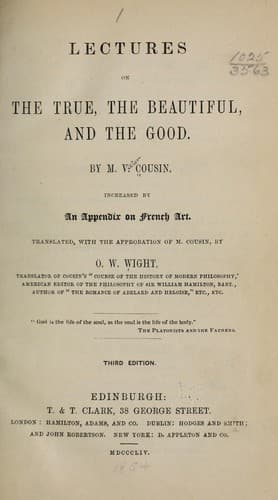
Lectures on the true, the beautiful and the goodCousin, Victor
Philosophy
Lectures on the true, the beautiful and the good
Cousin, Victor
Aesthetics; Ethics; Truth
We now know what God truly is. We have already seen two of his adorable
attributes,--truth and beauty. The most august attribute is revealed to
us,--holiness. God is the holy of holies, as the author of the moral law
and the good, as the principle of liberty, justice, and charity, as the
dispenser of penalty and reward. Such a God is not an abstract God, but
an intelligent and free person, who has made us in his own image, from
whom we hold the law itself that presides over our destiny, whose
judgments we await. It is his love that inspires us in our acts of
charity; it is his justice that governs our justice, that of our
societies and our laws. If we do not continually remind ourselves that
he is infinite, we degrade his nature; but he would be for us as if he
were not, if his infinite essence had no forms that pertain to us, the
proper forms of our reason and our soul.
By thinking upon such a being, man feels a sentiment that is _par
excellence_ the religious sentiment. All the beings with whom we are in
relation awaken in us different sentiments, according to the qualities
that we perceive in them; and should he who possesses all perfections
excite in us no particular sentiment? When we think upon the infinite
essence of God, when we are penetrated with his omnipotence, when we are
reminded that the moral law expresses his will, that he attaches to the
fulfilment and the violation of this law recompenses and penalties which
he dispenses with an inflexible justice, we cannot guard ourselves
against an emotion of respect and fear at the idea of such a grandeur.
Then, if we come to consider that this all-powerful being has indeed
wished to create us, us of whom he has no need, that in creating us he
has loaded us with benefits, that he has given us this admirable
universe for enjoying its ever-new beauties, society for ennobling our
life in that of our fellow-men, reason for thinking, the heart for
loving, liberty for acting; without disappearing, respect and fear are
tinged with a sweeter sentiment, that of love. Love, when it is applied
to feeble and limited beings, inspires us with a desire to do good to
them; but in itself it proposes to itself no advantage from the person
loved; we love a beautiful or good object, because it is beautiful or
good, without at first regarding whether this love may be useful to its
object and ourselves. For a still stronger reason, love, when it ascends
to God, is a pure homage rendered to his perfections; it is the natural
overflow of the soul towards a being infinitely lovable.
Public-domain text, read in full here on John Shaqi.
Reviews
Reviews
No reviews yet
Be the first to share your thoughts on this work.
Elsewhere in the archive
Join the Discussion
Join the discussion
Sign in to leave a comment or review.
Sign InorCreate an account