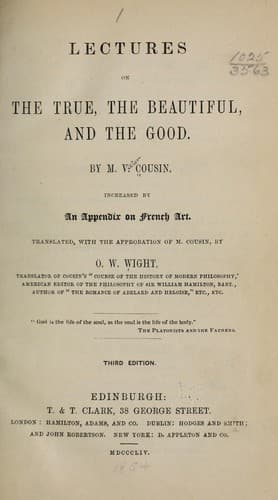
Lectures on the true, the beautiful and the goodCousin, Victor
Philosophy
Lectures on the true, the beautiful and the good
Cousin, Victor
Aesthetics; Ethics; Truth
Respect and love compose adoration. True adoration does not exist
without possessing both of these sentiments. If you consider only the
all-powerful God, master of heaven and earth, author and avenger of
justice, you crush man beneath the weight of the grandeur of God and his
own feebleness, you condemn him to a continual trembling in the
uncertainty of God's judgments, you make him hate the world, life, and
himself, for every thing is full of misery. Towards this extreme,
Port-Royal inclines. Read the _Pensees de Pascal_.[257] In his great
humility, Pascal forgets two things,--the dignity of man and the love of
God. On the other hand, if you see only the good God and the indulgent
father, you incline to a chimerical mysticism. By substituting love for
fear, little by little with fear, we run the risk of losing respect. God
is no more a master, he is no more even a father; for the idea of a
father still to a certain point involves that of a respectful fear; he
is no more any thing but a friend, sometimes even a lover. True
adoration does not separate love and respect; it is respect animated by
love.
Adoration is a universal sentiment. It differs in degrees according to
different natures; it takes the most different forms; it is often even
ignorant of itself; sometimes it is revealed by an exclamation springing
from the heart, in the midst of the great scenes of nature and life,
sometimes it silently rises in the mute and penetrated soul; it may err
in its expressions, even in its object; but at bottom it is always the
same. It is a spontaneous, irresistible emotion of the soul; and when
reason is applied to it, it is declared just and legitimate. What, in
fact, is more just than to fear the judgments of him who is holiness
itself, who knows our actions and our intentions, and will judge them
according to the highest justice? What, too, is more just than to love
perfect goodness and the source of all love? Adoration is at first a
natural sentiment; reason makes it a duty.
Adoration confined to the sanctuary of the soul is what is called
internal worship--the necessary principle of all public worships.
Public-domain text, read in full here on John Shaqi.
Reviews
Reviews
No reviews yet
Be the first to share your thoughts on this work.
Elsewhere in the archive
Join the Discussion
Join the discussion
Sign in to leave a comment or review.
Sign InorCreate an account