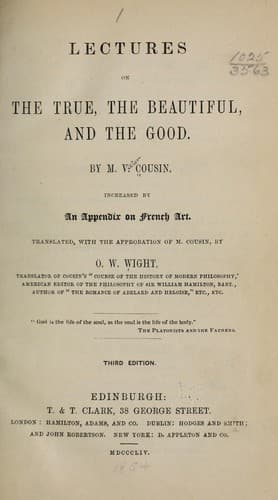
Lectures on the true, the beautiful and the goodCousin, Victor
Philosophy
Lectures on the true, the beautiful and the good
Cousin, Victor
Aesthetics; Ethics; Truth
[250] 3d Series, vol. iv., advertisement to the 3d edition: "Without
vain subtilty, there is a real distinction between free will and
spontaneous liberty. Arbitrary freedom is volition with the appearance
of deliberation between different objects, and under this supreme
condition, that when, as a consequence of deliberation, we resolve to do
this or that, we have the immediate consciousness of having been able,
and of being able still, to will the contrary. It is in volition, and in
the retinue of phenomena which surround it, that liberty more
energetically appears, but it is not thereby exhausted. It is at rare
and sublime moments in which liberty is as much greater as it appears
less to the eyes of a superficial observation. I have often cited the
example of d'Assas. D'Assas did not deliberate; and for all that, was
d'Assas less free, did he not act with entire liberty? Has the saint
who, after a long and painful exercise of virtue, has come to practise,
as it were by nature, the acts of self-renunciation which are repugnant
to human weakness; has the saint, in order to have gone out from the
contradictions and the anguish of this form of liberty which we called
volition, fallen below it instead of being elevated above it; and is he
nothing more than a blind and passive instrument of grace, as Luther and
Calvin have inappropriately wished to call it, by an excessive
interpretation of the Augustinian doctrine? No, freedom still remains;
and far from being annihilated, its liberty, in being purified, is
elevated and ennobled; from the human form of volition it has passed to
the almost divine form of spontaneity. Spontaneity is essentially free,
although it may be accompanied with no deliberation, and although often,
in the rapid motion of its inspired action, it escapes its own
observation, and leaves scarcely a trace in the depths of consciousness.
Let us transfer this exact psychology to theodicea, and we may recognize
without hypothesis, that spontaneity is also especially the form of
God's liberty. Yes, certainly, God is free; for, among other proofs, it
would be absurd that there should be less freedom in the first cause
than in one of its effects, humanity; God is free, but not with that
liberty which is related to our double nature, and made to contend
against passion and error, and painfully to engender virtue and our
imperfect knowledge; he is free, with a liberty that is related to his
own divine nature, that is a liberty unlimited, infinite, recognizing no
obstacle. Between justice and injustice, between good and evil, between
reason and its contrary, God cannot deliberate, and, consequently,
cannot will after our manner. Can one conceive, in fact, that he could
take what we call the bad part? This very supposition is impious. It is
necessary to admit that when he has taken the contrary part, he has
acted freely without doubt, but not arbitrarily, and with the
consciousness of having been able to choose the other part. His nature,
Public-domain text, read in full here on John Shaqi.
Reviews
Reviews
No reviews yet
Be the first to share your thoughts on this work.
Elsewhere in the archive
Join the Discussion
Join the discussion
Sign in to leave a comment or review.
Sign InorCreate an account