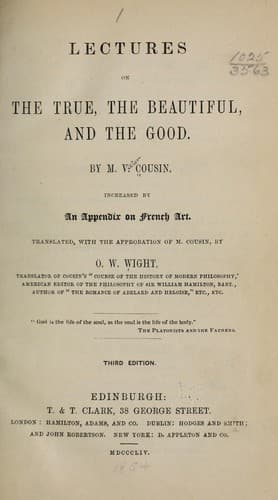
Lectures on the true, the beautiful and the goodCousin, Victor
Philosophy
Lectures on the true, the beautiful and the good
Cousin, Victor
Aesthetics; Ethics; Truth
pretension of small, exclusive, and fanatical minds; the duty, more
imperative now than ever, of whomsoever has for either a serious and
enlightened love, is to bring together and unite, instead of dividing
and wasting the powers of the mind and the soul, in the interest of the
common cause and the great object which the Christian religion and
philosophy pursue, each in its own way,--I mean the moral grandeur of
humanity.[262]
FOOTNOTES:
[245] Lectures 4 and 7.
[246] Such is the common vice of nearly all theodiceas, without
excepting the best--that of Leibnitz, that of Clarke; even the most
popular of all, the _Profession de Foi du Vicaire Savoyard_. See our
small work entitled _Philosophie Populaire_, 3d edition, p. 82.
[247] On the Cartesian argument, see above, part 1st, lecture 4; see
also 1st Series, vol. iv., lecture 12, and especially vol. v., lecture
6.
[248] _Fragments de Philosophie Cartesienne_, p. 24: "The infinite
being, inasmuch as infinite, is not a mover, a cause; neither is he,
inasmuch as infinite, an intelligence; neither is he a will; neither is
he a principle of justice, nor much less a principle of love. We have no
right to impute to him all these attributes in virtue of the single
argument that every contingent being supposes a being that is not so,
that every finite supposes an infinite. The God given by this argument
is the God of Spinoza, is rigorously so; but he is almost as though he
were not, at least for us who with difficulty perceive him in the
inaccessible heights of an eternity and existence that are absolute,
void of thought, of liberty, of love, similar to nonentity itself, and a
thousand times inferior, in his infinity and eternity, to an hour of our
finite and perishable existence, if during this fleeting hour we know
what we are, if we think, if we love something else than ourselves, if
we feel capable of freely sacrificing to an idea the few minutes that
have been accorded to us."
[249] This theodicea is here _in resume_, and in the 4th and 5th
lectures of part first, as well as in the lecture that follows. The most
important of our different writings, on this point, will be found
collected and elucidated by each other, in the Appendix to the 5th
lecture of the first volume of the 1st Series.--See our translation of
this entire Series of M. Cousin's works, under the title of the History
of Modern Philosophy.
Public-domain text, read in full here on John Shaqi.
Reviews
Reviews
No reviews yet
Be the first to share your thoughts on this work.
Elsewhere in the archive
Join the Discussion
Join the discussion
Sign in to leave a comment or review.
Sign InorCreate an account