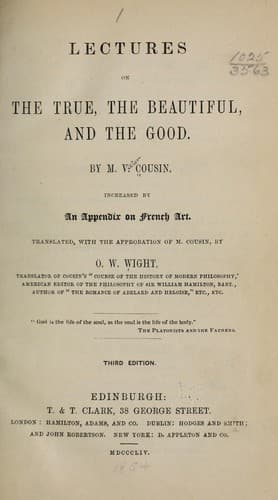
Lectures on the true, the beautiful and the goodCousin, Victor
Philosophy
Lectures on the true, the beautiful and the good
Cousin, Victor
Aesthetics; Ethics; Truth
[262] We have not ceased to claim, to earnestly call for, the alliance
between Christianity and philosophy, as well as the alliance between the
monarchy and liberty. See particularly 3d Series, vol. iv., _Philosophie
Contemporaine_, preface of the second edition; 4th Series, vol. i.,
_Pascal_, 1st and 2d preface, _passim_; 5th Series, vol. ii., _Discours
a la Chambre des Paris pour le Defence de l'Universite et de la
Philosophie_. We everywhere profess the most tender veneration for
Christianity,--we have only repelled the servitude of philosophy, with
Descartes, and the most illustrious doctors of ancient and modern times,
from St. Augustine and St. Thomas, to the Cardinal de la Lucerne and the
Bishop of Hermopolis. Moreover, we love to think that those quarrels,
originating in other times from the deplorable strife between the clergy
and the University, have not survived it, and that now all sincere
friends of religion and philosophy will give each other the hand, and
will work in concert to encourage desponding souls and lift up burdened
characters.
LECTURE XVII.
RESUME OF DOCTRINE.
Review of the doctrine contained in these lectures, and the
three orders of facts on which this doctrine rests, with the
relation of each one of them to the modern school that has
recognized and developed it, but almost always exaggerated
it.--Experience and empiricism.--Reason and idealism.--Sentiment
and mysticism.--Theodicea. Defects of different known
systems.--The process that conducts to true theodicea, and the
character of certainty and reality that this process gives to
it.
Having arrived at the limit of this course, we have a final task to
perform,--it is necessary to recall its general spirit and most
important results.
From the first lecture, I have signalized to you the spirit that should
animate this instruction,--a spirit of free inquiry, recognizing with
joy the truth wherever found, profiting by all the systems that the
eighteenth century has bequeathed to our times, but confining itself to
none of them.
The eighteenth century has left to us as an inheritance three great
schools which still endure--the English and French school, whose chief
is Locke, among whose most accredited representatives are Condillac,
Helvetius, and Saint-Lambert; the Scotch school, with so many celebrated
names, Hutcheson, Smith, Reid, Beattie, Ferguson, and Dugald
Stewart;[263] the German school, or rather school of Kant, for, of all
the philosophers beyond the Rhine, the philosopher of Koenigsberg is
almost the only one who belongs to history. Kant died at the beginning
of the nineteenth century;[264] the ashes of his most illustrious
disciple, Fichte,[265] are scarcely cold. The other renowned
philosophers of Germany still live,[266] and escape our valuation.
Public-domain text, read in full here on John Shaqi.
Reviews
Reviews
No reviews yet
Be the first to share your thoughts on this work.
Elsewhere in the archive
Join the Discussion
Join the discussion
Sign in to leave a comment or review.
Sign InorCreate an account