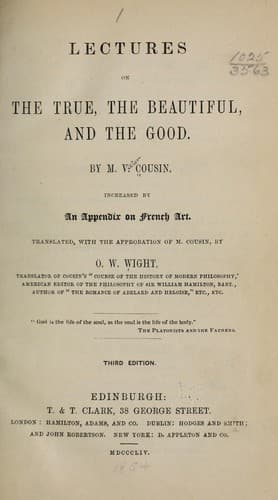
Lectures on the true, the beautiful and the goodCousin, Victor
Philosophy
Lectures on the true, the beautiful and the good
Cousin, Victor
Aesthetics; Ethics; Truth
But this is only an ethnographical enumeration of the schools of the
eighteenth century. It is above all necessary to consider them in their
characters, analogous or opposite. The Anglo-French school particularly
represents empiricism and sensualism, that is to say, an almost
exclusive importance attributed in all parts of human knowledge to
experience in general, and especially to sensible experience. The Scotch
school and the German school represent a more or less developed
spiritualism. Finally, there are philosophers, for example, Hutcheson,
Smith, and others, who, mistrusting the senses and reason, give the
supremacy to sentiment.
Such are the philosophic schools in the presence of which the nineteenth
century is placed.
We are compelled to avow, that none of these, to our eyes, contains the
entire truth. It has been demonstrated that a considerable part of
knowledge escapes sensation, and we think that sentiment is a basis
neither sufficiently firm, nor sufficiently broad, to support all human
science. We are, therefore, rather the adversary than the partisan of
the school of Locke and Condillac, and of that of Hutcheson and Smith.
Are we on that account the disciple of Reid and Kant? Yes, certainly, we
declare our preference for the direction impressed upon philosophy by
these two great men. We regard Reid as common sense itself, and we
believe that we thus eulogize him in a manner that would touch him most.
Common sense is to us the only legitimate point of departure, and the
constant and inviolable rule of science. Reid never errs; his method is
true, his general principles are incontestable, but we will willingly
say to this irreproachable genius,--_Sapere aude_. Kant is far from
being as sure a guide as Reid. Both excel in analysis; but Reid stops
there, and Kant builds upon analysis a system irreconcilable with it. He
elevates reason above sensation and sentiment; he shows with great skill
how reason produces by itself, and by the laws attached to its exercise,
nearly all human knowledge; there is only one misfortune, which is that
all this fine edifice is destitute of reality. Dogmatical in analysis,
Kant is skeptical in his conclusions. His skepticism is the most
learned, most moral, that ever existed; but, in fine, it is always
skepticism. This is saying plainly enough that we are far from belonging
to the school of the philosopher of Koenigsberg.
Public-domain text, read in full here on John Shaqi.
Reviews
Reviews
No reviews yet
Be the first to share your thoughts on this work.
Elsewhere in the archive
Join the Discussion
Join the discussion
Sign in to leave a comment or review.
Sign InorCreate an account