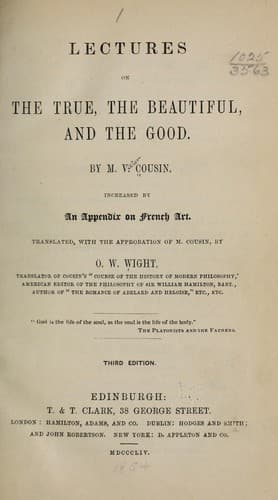
Lectures on the true, the beautiful and the goodCousin, Victor
Philosophy
Lectures on the true, the beautiful and the good
Cousin, Victor
Aesthetics; Ethics; Truth
There is in the philosophy of sensation what is true and what is false.
The false is the pretension of explaining all human knowledge by the
acquisitions of the senses; this pretension is the system itself; we
reject it, and the system with it. The true is that sensibility,
considered in its external and visible organs, and in its internal
organs, the invisible seats of the vital functions, is the indispensable
condition of the development of all our faculties, not only of the
faculties that evidently pertain to sensibility, but of those that seem
to be most remote from it. This true side of sensualism we have
everywhere recognized and elucidated in metaphysics, aesthetics, ethics,
and theodicea.
For us, theodicea, ethics, aesthetics, metaphysics, rest on psychology,
and the first principle of our psychology is that the condition of all
exercise of mind and soul is an impression made on our organs, and a
movement of the vital functions.
Man is not a pure spirit; he has a body which is for the spirit
sometimes an obstacle, sometimes a means, always an inseparable
companion. The senses are not, as Plato and Malebranche have too often
said, a prison for the soul, but much rather windows looking out upon
nature, through which the soul communicates with the universe. There is
an entire part of Locke's polemic against the theories of innate ideas
that is to our eyes perfectly true. We are the first to invoke
experience in philosophy. Experience saves philosophy from hypothesis,
from abstraction, from the exclusively deductive method, that is to say,
from the geometrical method. It is on account of having abandoned the
solid ground of experience, that Spinoza, attaching himself to certain
sides of Cartesianism,[267] and closing his eyes to all the others,
forgetting its method, its essential character, and its most certain
principles, reared a hypothetical system, or made from an arbitrary
definition spring with the last degree of rigor a whole series of
deductions, which have nothing to do with reality. It is also on account
of having exchanged experience for a systematic analysis, that
Condillac, an unfaithful disciple of Locke, undertook to draw from a
single fact, and from an ill-observed fact, all knowledge, by the aid of
a series of verbal transformations, whose last result is a nominalism,
like that of the later scholastics. Experience does not contain all
science, but it furnishes the conditions of all science. Space is
nothing for us without visible and tangible bodies that occupy it, time
is nothing without the succession of events, cause without its effects,
substance without its modes, law without the phenomena that it
rules.[268] Reason would reveal to us no universal and necessary truth,
if consciousness and the senses did not suggest to us particular and
contingent notions. In aesthetics, while severely distinguishing between
the beautiful and the agreeable, we have shown that the agreeable is the
Public-domain text, read in full here on John Shaqi.
Reviews
Reviews
No reviews yet
Be the first to share your thoughts on this work.
Elsewhere in the archive
Join the Discussion
Join the discussion
Sign in to leave a comment or review.
Sign InorCreate an account