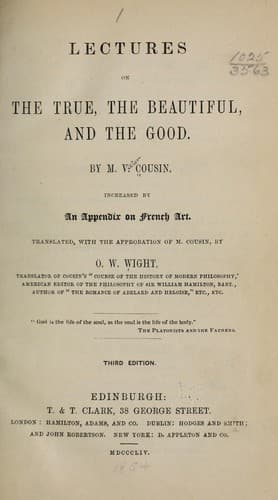
Lectures on the true, the beautiful and the goodCousin, Victor
Philosophy
Lectures on the true, the beautiful and the good
Cousin, Victor
Aesthetics; Ethics; Truth
In general, in the history of philosophy, we are in favor of systems
that are themselves in favor of reason. Accordingly, in antiquity, we
side with Plato against his adversaries; among the moderns, with
Descartes against Locke, with Reid against Hume, with Kant against both
Condillac and Smith. But while we acknowledge reason as a power superior
to sensation and sentiment, as being, _par excellence_, the faculty of
every kind of knowledge, the faculty of the true, the faculty of the
beautiful, the faculty of the good, we are persuaded that reason cannot
be developed without conditions that are foreign to it, cannot suffice
for the government of man without the aid of another power: that power
which is not reason, which reason cannot do without, is sentiment; those
conditions, without which reason cannot be developed, are the senses. It
is seen what for us is the importance of sensation and sentiment: how,
consequently, it is impossible for us absolutely to condemn either the
philosophy of sensation, or, much more, that of sentiment.
Such are the very simple foundations of our eclecticism. It is not in us
the fruit of a desire for innovation, and for making ourself a place
apart among the historians of philosophy; no, it is philosophy itself
that imposes on us our historical views. It is not our fault if God has
made the human soul larger than all systems, and we also aver that we
are also much rejoiced that all systems are not absurd. Without giving
the lie to the most certain facts signalized and established by ourself,
it was indeed necessary, on finding them scattered in the history of
philosophy, to recognize and respect them, and if the history of
philosophy, thus considered, no longer appeared a mass of senseless
systems, a chaos, without light, and without issue; if, on the contrary,
it became, in some sort, a living philosophy, that was, it should seem,
a progress on which one might felicitate himself, one of the most
fortunate conquests of the nineteenth century, the very triumphing of
the philosophic spirit.
We have, therefore, no doubt in regard to the excellence of the
enterprise; the whole question for us is in the execution. Let us see,
let us compare what we have done with what we have wished to do.
Let us ask, in the first place, whether we have been just towards that
great philosophy represented in antiquity by Aristotle, whose best model
among the moderns is the wise author of the Essay on the _Human
Understanding_.
Public-domain text, read in full here on John Shaqi.
Reviews
Reviews
No reviews yet
Be the first to share your thoughts on this work.
Elsewhere in the archive
Join the Discussion
Join the discussion
Sign in to leave a comment or review.
Sign InorCreate an account