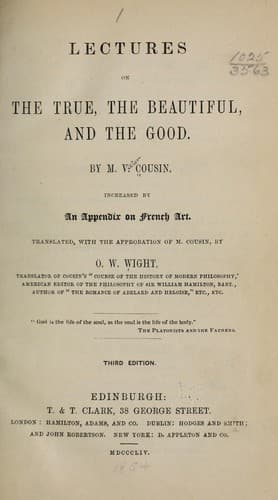
Lectures on the true, the beautiful and the goodCousin, Victor
Philosophy
Lectures on the true, the beautiful and the good
Cousin, Victor
Aesthetics; Ethics; Truth
[2] The Appendix has been translated by Mr. N. E. S. A. Hamilton of the
British Museum, who is alone entitled to credit and alone
responsible.--TR.
TRANSLATOR'S PREFACE.
The nature of this publication is sufficiently explained in the preface
of M. Cousin.
We have attempted to render his book, without comment, faithfully into
English. Not only have we endeavored to give his thought without
increase or diminution, but have also tried to preserve the main
characteristics of his style. On the one hand, we have carefully shunned
idioms peculiar to the French; on the other, when permitted by the laws
of structure common to both languages, we have followed the general
order of sentences, even the succession of words. It has been our aim to
make this work wholly Cousin's in substance, and in form as nearly his
as possible, with a total change of dress. That, however, we may have
nowhere missed a shade of meaning, nowhere introduced a gallicism, is
too much to be hoped for, too much to be demanded.
M. Cousin, in his Philosophical Discussions, defines the terms that he
uses. In the translation of these we have maintained uniformity, so that
in this regard no farther explanation is necessary.
This is, perhaps, in a philosophical point of view, the most important
of all M. Cousin's works, for it contains a complete summary and lucid
exposition of the various parts of his system. It is now the last word
of European philosophy, and merits serious and thoughtful attention.
This and many more like it, are needed in these times, when noisy and
pretentious demagogues are speaking of metaphysics with idiotic
laughter, when utilitarian statesmen are sneering at philosophy, when
undisciplined sectarians of every kind are decrying it; when, too,
earnest men, in state and church, men on whose shoulders the social
world really rests, are invoking philosophy, not only as the best
instrument of the highest culture and the severest mental discipline,
but also as the best human means of guiding politics towards the
eternally true and the eternally just, of preserving theology from the
aberrations of a zeal without knowledge, and from the perversion of the
interested and the cunning; when many an artist, who feels the nobility
of his calling, who would address the mind of man rather than his
senses, is asking a generous philosophy to explain to him that ravishing
and torturing Ideal which is ever eluding his grasp, which often
discourages unless understood; when, above all, devout and tender souls
are learning to prize philosophy, since, in harmony with Revelation, it
strengthens their belief in God, freedom, immortality.
Public-domain text, read in full here on John Shaqi.
Reviews
Reviews
No reviews yet
Be the first to share your thoughts on this work.
Join the Discussion
Join the discussion
Sign in to leave a comment or review.
Sign InorCreate an account