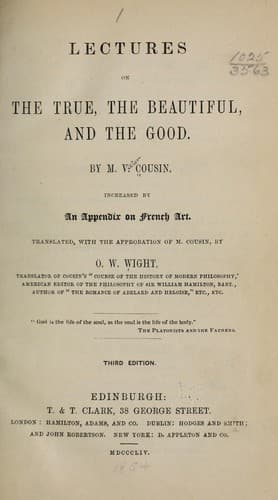
Lectures on the true, the beautiful and the goodCousin, Victor
Philosophy
Lectures on the true, the beautiful and the good
Cousin, Victor
Aesthetics; Ethics; Truth
At first, if any one should pretend that in Plato Ideas are beings
subsisting by themselves, without interconnection and without relation
to a common centre, numerous passages of the _Timaeus_ might be objected
to him,[47] in which Plato speaks of Ideas as forming in their whole an
ideal unity, which is the reason of the unity of the visible world.[48]
Will it be said that this ideal world forms a distinct unity, a unity
separate from God? But, in order to sustain this assertion, it is
necessary to forget so many passages of the _Republic_, in which the
relations of truth and science with the Good, that is to say, with God,
are marked in brilliant characters.
Let not that magnificent comparison be forgotten, in which, after having
said that the sun produces in the physical world light and life,
Socrates adds: "So thou art able to say, intelligible beings not only
hold from the _Good_ that which renders them intelligible, but also
their being and their essence."[49] So, intelligible beings, that is to
say, Ideas, are not beings that exist by themselves.
Men go on repeating with assurance that the Good, in Plato, is only the
idea of the good, and that an idea is not God. I reply, that the Good is
in fact an idea, according to Plato, but that the idea here is not a
pure conception of the mind, an object of thought, as the peripatetic
school understood it; I add, that the Idea of the Good is in Plato the
first of Ideas, and that, for this reason, while remaining for us an
object of thought, it is confounded as to existence with God. If the
Idea of the Good is not God himself, how will the following passage,
also taken from the _Republic_, be explained? "At the extreme limits of
the intellectual world is the Idea of the Good, which is perceived with
difficulty, but, in fine, cannot be perceived without concluding that it
is the source of all that is beautiful and good; that in the visible
world it produces light, and the star whence the light directly comes,
that in the invisible world it directly produces truth and
intelligence."[50] Who can produce, on the one hand, the sun and light,
on the other, truth and intelligence, except a real being?
Public-domain text, read in full here on John Shaqi.
Reviews
Reviews
No reviews yet
Be the first to share your thoughts on this work.
Join the Discussion
Join the discussion
Sign in to leave a comment or review.
Sign InorCreate an account